

Table of Contents
- Which Southeast Asian Languages Do AI Translation Earbuds Actually Cover?
- How to Use Real-Time Translation Earbuds in Southeast Asia
- Real-World Accuracy: Thai, Vietnamese, and Bahasa Indonesia Performance
- Offline vs. Online Performance and Data Privacy
- The Limitations of AI Voice Translation Technology in Practice
- Best AI Translation Earbuds for Travel: What to Look For
- Making Your Choice: Matching Earbuds to Your Itinerary
- Final Thoughts on AI Translation Earbuds for Southeast Asia
- Frequently Asked Questions
Last Updated: September 6, 2026
Do AI translation earbuds support Southeast Asian languages? Yes, but support depth varies by language, model, and online or offline mode. For travelers to Thailand, Vietnam, or Indonesia, these distinctions matter more than marketing claims. This guide from ELTStores breaks down real-world performance so you can choose a pair that works.

Most modern translation earbuds rely on cloud-based processing to convert speech to text, translate it, and speak the result. Quality depends heavily on the language database behind the app. The gap between supported and genuinely useful languages is a significant factor in whether these devices end up in a drawer or in daily carry.
Which Southeast Asian Languages Do AI Translation Earbuds Actually Cover?
The headline number on the box, often 100 to 144 languages, is a marketing metric, not a performance guarantee. For Southeast Asia, the practical reality is that support clusters around the national languages: Thai, Vietnamese, and Bahasa Indonesia. These are the languages with the largest digital footprints, meaning the machine learning models behind the translation apps have enough training data to produce usable results. You will find these three on virtually every spec sheet.
However, the region's linguistic diversity is far more complex than a list of national languages suggests. A device that handles Bahasa Indonesia may completely fail on Javanese or Sundanese, which are separate languages with tens of millions of native speakers. Similarly, Tagalog is not the same as the many regional languages of the Philippines. Before you buy, verify that the specific language you need is listed, not just a closely related one.
The Dialect Problem: Why 'Thai' Isn't Enough
The most significant gap between marketing and real-world utility is dialect handling. Thai is tonal with five tones, and the central Bangkok dialect dominates training data. Travel to the northeast or far south, and accents can confuse voice recognition, shifting tonal contours and leading to different meanings.
Vietnamese presents a similar challenge. Northern and Southern dialects differ in consonant and vowel pronunciation, and accuracy drops with strong regional accents. Southern final consonants are often softened or dropped, causing mishearing. Look for documentation specifying accent support, not just the language name.
Bahasa Indonesia vs. Bahasa Melayu
Another common point of confusion is the distinction between Bahasa Indonesia and Bahasa Melayu (Malay). While they are mutually intelligible at a basic level, they have different vocabularies, slang, and pronunciation. A device optimized for Bahasa Indonesia may sound awkward or fail to recognize certain words when used in Malaysia. If your itinerary includes both countries, check whether the companion app lists them as separate language options.
How to Verify Support Before You Buy
The most reliable way to check real-world support is to look at the companion app's language selection menu, not the marketing page. Download the app and search for the specific language you need. If the language is present, test it with a sample phrase in the dialect you expect to encounter. Many manufacturers offer a free tier or demo mode that lets you test translation quality without pairing the earbuds. This five-minute check is worth more than any spec sheet.
How to Use Real-Time Translation Earbuds in Southeast Asia
Using real-time translation earbuds effectively requires more than pairing. Download the companion app and connect via Bluetooth before you travel, since app stores and connectivity can be unreliable in some areas.

For each conversation, select your language pair in the app, then place the phone between you and the other speaker. The earbuds capture your voice through microphone sensitivity, while the phone picks up the other person's speech. This is a conversational flow, not a simultaneous interpretation setup, so you need to pause after each sentence to let the system process and speak. Expect a short latency of one to three seconds per exchange, which feels natural once you adjust your pacing.
| Step | Action | Time Needed |
|---|---|---|
| 1 | Download companion app and pair earbuds | 5 minutes |
| 2 | Download offline language packs if needed | 10 minutes |
| 3 | Select language pair before conversation | 30 seconds |
| 4 | Place phone between speakers, pause after sentences | Ongoing |
Real-World Accuracy: Thai, Vietnamese, and Bahasa Indonesia Performance
Street-level performance is where marketing claims meet reality. Thai and Vietnamese often produce reliable results for everyday exchanges like ordering food, asking directions, and negotiating prices at markets. Bahasa Indonesia also performs well in urban centers where speakers use the standardized form. The accuracy stems from these languages having substantial written corpora for the machine learning models to train on.
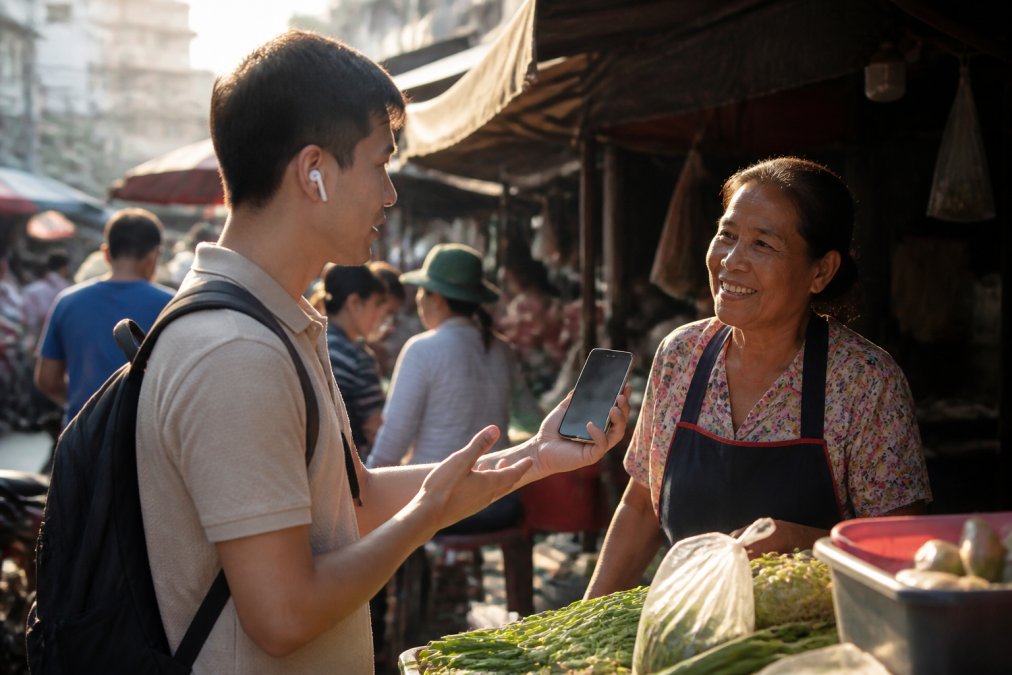
Noise is the enemy of accuracy. Ambient sound from busy markets or scooter-filled intersections can overwhelm microphones, causing dropped words or misheard tones. Thai is tonal, so a misheard tone changes meaning entirely. For important conversations, find a quiet spot and speak clearly.
Offline vs. Online Performance and Data Privacy
The single most important technical decision you will make is whether to rely on online or offline translation. This choice determines your accuracy ceiling, your data costs, and your privacy exposure. The tradeoff is not uniform across Southeast Asian languages, and understanding the specifics can save you from a failed conversation in a remote area.
Online Mode: The Accuracy Ceiling
Online mode sends speech to cloud servers, giving access to a full model that is larger and more accurate than anything on your phone. For Thai, Vietnamese, and Bahasa Indonesia, it is the only way to get near-real-time, natural-sounding translations. Cloud models include contemporary slang, idioms, and code-switching common in urban centers.
The catch is connectivity. A stable 4G or 5G connection is required. In major cities this is rarely a problem, but on islands like Koh Tao, Vietnam's Mekong Delta, or Sumatra's highlands, signal can drop to 3G or disappear. When that happens, online mode fails unless you have downloaded offline packs.
Offline Mode: The Coverage Reality
Offline language packs are where marketing claims often break down. A device may advertise 144 languages online, but the offline list is typically 10 to 20 (consumerreports.org). Bahasa Indonesia and Thai are more likely to have robust offline packs; Vietnamese packs exist but may be less accurate, particularly for the Southern dialect.
Offline translation runs a compressed model on your phone, which is smaller and less sophisticated than the cloud version. Accuracy drops, especially with tonal languages like Thai and Vietnamese. For basic phrases like "how much is this?" offline mode is adequate; for nuance, numbers, or directions, go online.
Data Privacy: What Happens to Your Speech
In online mode, your audio is transmitted to the provider's servers (the FTC). Most consumer apps store this data temporarily to improve models, but retention policies vary. For casual travel conversations this is negligible risk. For business travelers discussing contracts or proprietary information, assume anything said online is recorded and analyzed.
The practical workaround is to use offline mode for sensitive conversations. The accuracy will be lower, but the audio never leaves your device. Some companion apps also offer a privacy setting that disables cloud processing entirely. Check the app's settings menu before your trip and decide which mode you will use for which types of conversations.
The eSIM Advantage
For most travelers, the best solution is to carry a local eSIM or physical SIM card with a data plan. Thailand, Vietnam, and Indonesia all have affordable prepaid data plans, often under $15 for 30 days with 10-20 GB of data (statista.com). With a local data connection, online mode becomes practical for the entire trip, even in semi-rural areas where 4G coverage is surprisingly robust. The cost of a local SIM is far less than the frustration of a failed offline translation at a critical moment.
The Limitations of AI Voice Translation Technology in Practice
AI voice translation has improved rapidly but still has clear boundaries. The most significant limitation is contextual understanding: systems translate words accurately but miss cultural subtext, humor, and politeness levels. Thai has multiple speech registers depending on social hierarchy, and direct translation may come across as overly blunt even when correct.
Speech synthesis also lags behind translation quality. The generated voice often sounds robotic, and for tonal languages it can flatten tones that carry meaning. The practical workaround is to show the phone screen when spoken translation fails, since reading is often easier. For casual travel these devices are genuinely helpful; for nuanced business negotiations, they are a supplement, not a replacement.
Best AI Translation Earbuds for Travel: What to Look For
When evaluating the best AI translation earbuds for travel, focus on four specifications rather than the headline language count. Battery life is the first filter: look for a case with multiple charges and earbuds that sustain several hours of continuous translation, not just music playback.
The second filter is the companion app's language list, specifically offline packs. The third is microphone quality, since dual or beamforming microphones improve recognition in noisy environments. Finally, consider OTA updates, which let manufacturers improve algorithms and add languages after purchase. The ELTStores 3-in-1 AI Real-Time Language Translation Earbuds cover 144 languages and accents with long battery life, making them a strong option. For a budget pick, the Lingo Buds AI Translation Earbuds offer the same coverage with USB-C fast charging, while the TWS Bluetooth Translation Headphones provide a compact, touch-control alternative.

Making Your Choice: Matching Earbuds to Your Itinerary
Your itinerary should dictate which earbuds you buy. For major cities like Bangkok, Hanoi, or Jakarta, online mode gives the best accuracy, so prioritize a reliable companion app and strong connectivity. For islands, national parks, or rural routes, offline packs become essential, confirm the languages you need are available for download.
Consider trip length and daily usage. A two-week multi-country tour demands longer battery life and a charging case, while a short business trip might allow a lighter pair. For frequent travelers, OTA updates ensure translation improves over time.
| Travel Scenario | Priority Feature | Recommended Focus |
|---|---|---|
| City-hopping in Thailand, Vietnam | Online accuracy, noise handling | Thai, Vietnamese language packs |
| Multi-country backpacking trip | Offline packs, long battery life | Bahasa Indonesia, offline mode |
| Business meetings in Jakarta | Data privacy, clear audio | Offline mode, dual microphones |
| Short weekend getaway | Ease of setup, portability | App quality, fast charging |
Final Thoughts on AI Translation Earbuds for Southeast Asia
AI translation earbuds do support Southeast Asian languages, and for the major languages of Thailand, Vietnam, and Indonesia, they are genuinely useful travel companions. The key is to separate marketing language counts from real-world performance, which depends on connectivity, noise, and dialect. Choose a pair that matches your itinerary, practice before you leave, and treat it as a tool that removes the first layer of the language barrier rather than a magic wand.
At ELTStores, we have curated translation earbuds that balance battery life, language coverage, and ease of use for travelers heading to the region. Our collection focuses on devices that simplify your daily routine, so you can spend less time fumbling with apps and more time connecting with the people around you. Explore our range of AI translation earbuds and find the pair that fits your next journey.
Frequently Asked Questions
Are Southeast Asian languages like Thai or Vietnamese supported by AI earbuds?
Yes, most modern AI translation earbuds support Thai, Vietnamese, and Bahasa Indonesia. The 3-in-1 AI Real-Time Language Translation Earbuds cover 144 languages and accents, which includes the major Southeast Asian languages. However, support for regional dialects within these countries is less consistent. Check the language list before buying if you plan to travel outside major cities where standard dialects are spoken.
How accurate are AI translation earbuds in noisy environments?
Accuracy drops noticeably in noisy settings like busy streets or markets. Background noise interferes with voice recognition, which affects the translation quality. Good earbuds with noise cancellation and multiple microphones perform better. For important conversations, find a quieter spot or speak clearly and directly into the microphone. Most earbuds achieve their stated accuracy in quiet conditions, not in chaotic real-world environments.
What is the difference between offline and online translation on AI earbuds?
Online translation uses cloud-based processing, which delivers better accuracy and handles more complex sentences. Offline translation relies on the earbuds' built-in language database, which is limited to a smaller set of languages and produces more literal translations. For Southeast Asian languages, online mode gives noticeably better results because the AI can access larger language models and handle regional expressions more effectively.
For travelers who want reliable communication across Southeast Asia, the right earbuds make all the difference. ELTStores offers translation devices with 144-language coverage, long battery life, and fast charging, designed to keep you connected from the first flight to the last market stall. Get started with ELTStores and travel with confidence.