

Table of Contents
- Why Indoor Cats Need Interactive Toys
- How to Choose the Right Interactive Toy for Your Cat
- Top Interactive Toys for Indoor Cats: Our Picks
- Cat Puzzle Feeders for Mental Stimulation and Mealtime Fun
- Automatic Cat Toys for Boredom When You're Away
- How to Play with Your Cat Effectively
- Conclusion: Build a Play Routine That Sticks
- Frequently Asked Questions
Last Updated: September 5, 2026
Why Indoor Cats Need Interactive Toys
Indoor cats live longer and safer lives than their outdoor counterparts, but that protection comes with a hidden cost: a sedentary lifestyle that goes against millions of years of feline instinct (avma.org). Without an outlet for their prey drive, many indoor cats develop behavioral issues like aggression, over-grooming, or destructive scratching. The best interactive toys provide the mental stimulation and physical exercise that keep your cat healthy, happy, and engaged.
Interactive play is not a luxury for indoor cats. It is a core component of feline enrichment that supports cognitive development and prevents boredom. Without it, cats often redirect their hunting energy toward furniture, curtains, or their owners' ankles.
How to Choose the Right Interactive Toy for Your Cat
Choosing the right toy comes down to understanding your cat's unique personality and behavioral needs. A toy that one cat adores might completely bore another. Diagnose your cat's primary play motivation and match it to a specific toy category.
Does your cat love chasing things that move quickly across the floor? A remote-controlled toy might be perfect. Does your cat prefer stalking and pouncing on stationary objects? A puzzle feeder could be the answer. Many owners buy the most popular toy without observing whether it matches their cat's natural play style.
Match Toys to Your Cat's Age and Activity Level
Kittens have boundless energy and short attention spans. They need toys that allow for bursts of high-intensity play followed by rest. Adult cats between one and seven years old benefit most from toys that mimic prey movement, like flying fish or wand toys that dart and hover unpredictably. Senior cats often prefer gentler stimulation like puzzle feeders that reward slow, deliberate problem-solving without requiring athletic leaps.
Activity level matters just as much as age. A highly active cat needs toys that encourage running and jumping. A more laid-back cat might prefer toys that stimulate the mind rather than the body. Observe your cat over a few days and note which types of movement capture their attention.
A Diagnostic Framework: Matching Toy Type to Behavioral Need
The most effective way to choose a toy is to first identify what your cat is trying to achieve with its behavior. Here is a practical framework that can help recommend specific enrichment tools:
- The Over-Groomer or Anxious Cat: If your cat is over-grooming or showing signs of stress, the need is for calming, focused activity. Puzzle feeders are a primary recommendation here. They force the cat to use its brain and paws in a repetitive, soothing motion. A slow feeder bowl or a simple treat-dispensing ball that requires pawing to release kibble is an excellent starting point.
- The Destructive Scratcher: Scratching is a marking and stretching behavior, not just a destructive habit. The best toys for this cat are not toys at all, but interactive scratchers that you can engage with. A horizontal cardboard scratcher that you drag along the floor mimics prey and allows the cat to dig in its claws. This satisfies the need to scratch while also providing a hunting simulation.
- The Attention-Seeking Cat: Cats that constantly meow or weave between your legs are often under-stimulated. The need here is for interactive play that involves you. Wand toys are a good option. The key is to mimic the erratic, fleeing motion of a bird or mouse. The [Remote Control Flying Fish(/products/remote-control-flying-fish) | eltstores.com] is an excellent automated version of this, as its unpredictable flight path can be controlled to simulate a challenging chase without you having to be on the floor for 20 minutes.
- The Obsessive Chaser: Some cats are fixated on movement, often staring at shadows or light reflections. For these cats, a toy that provides a satisfying 'capture' is crucial. Laser pointers are often recommended, but they can cause frustration if the cat never catches the 'prey.' The best approach is to end a laser session by landing the dot on a physical toy or a treat, allowing the cat to 'catch' it. The Remote Control Flying Fish is a better alternative because it is a physical object the cat can actually catch and hold, providing the full hunt sequence.
Top Interactive Toys for Indoor Cats: Our Picks
Our top pick for most indoor cats is the Remote Control Flying Fish from ELTStores. This toy transforms your living room into an aquatic playground by mimicking the erratic, unpredictable flight patterns of a bird or fish. The movement triggers your cat's instinct to chase and pounce in a way that static toys cannot match. Priced at $53.66, it is an investment, but one that pays off in daily enrichment for your cat.
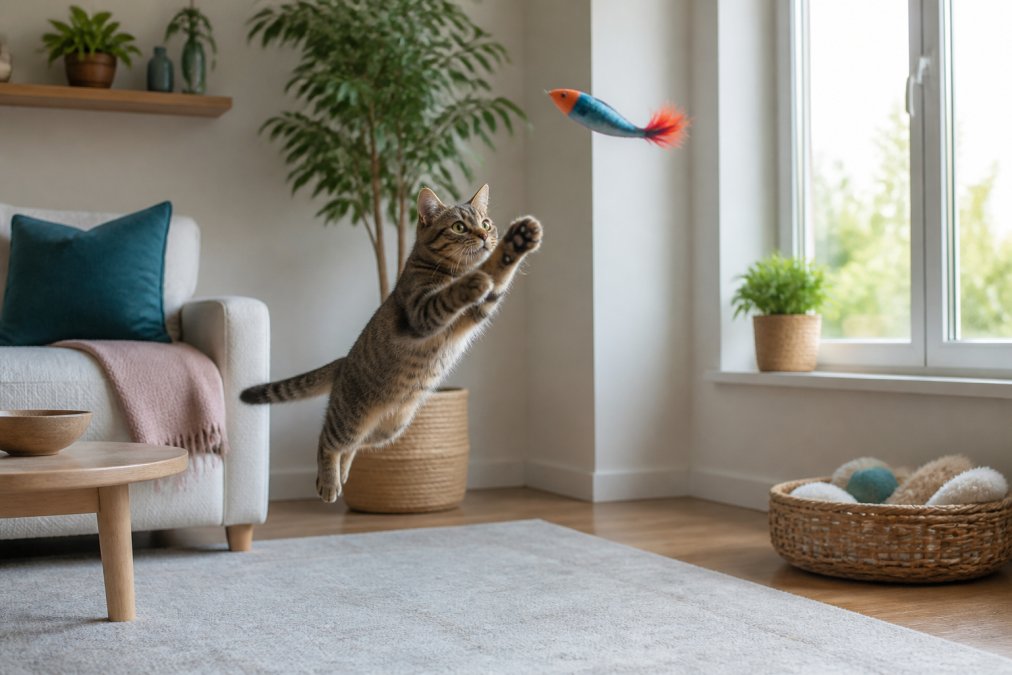
What makes this toy stand out is its realistic movement. It moves up and down with a full 360-degree range, reaching up to 40 feet away. Constructed from durable nylon, it can bounce off walls and obstacles without breaking. The helium balloon design keeps the fish afloat for up to two weeks, and it requires just four AAA batteries.
Remote Control Flying Fish
The Remote Control Flying Fish is best for cats that love to chase moving prey. You control the flight path, adjusting speed and direction to match your cat's energy level. For younger or more active cats, make the fish dart quickly. For older cats, keep it hovering at a lower height with gentler movements.
Recordable Pet Communication Buttons
For cats that want more interaction with their humans, the Recordable Pet Communication Button offers a different kind of engagement. This button lets you record a phrase, like "treat" or "play," and your cat learns to press it when they want something. Priced at $33.48, it turns playtime into a two-way conversation.

The button is made from durable, environmentally friendly ABS plastic. The operation is simple: long press the recording button, speak your phrase, and release. Compact at 8.5cm by 8.5cm by 4.1cm, it is easy to place anywhere.
Cat Puzzle Feeders for Mental Stimulation and Mealtime Fun
Cat puzzle feeders combine mealtime with problem-solving. Instead of eating from a bowl, your cat must work for their food by pawing, batting, or nudging the feeder to release kibble, tapping into the natural foraging instinct domestic cats still carry from their wild ancestors.
Puzzle feeders slow down fast eaters, reducing digestive upset and vomiting, and provide meaningful mental stimulation during a part of the day that would otherwise be passive. Start with a simple feeder that releases food easily, then progress to more complex designs as your cat builds confidence.
Automatic Cat Toys for Boredom When You're Away
Automatic cat toys are the closest thing to a playmate that works while you are at work. These motion-activated toys trigger your cat's prey drive without requiring you to hold a wand or remote, making them especially valuable for single-cat households.
The Remote Control Flying Fish doubles as an excellent automatic toy option. Set it moving before you leave, and the unpredictable flight path will keep your cat engaged. The helium balloon keeps it aloft, so your cat can chase, bat, and pounce without the toy getting stuck under furniture.
For cats that respond better to ground-based movement, consider toys that roll or scurry across the floor. The key is motion that mimics prey. A toy that moves in straight lines at a constant speed will bore your cat quickly. Look for toys with erratic, changing movement patterns.
How to Play with Your Cat Effectively
How you play matters as much as what you play with. Many owners wiggle a toy in front of their cat's face, which overwhelms the senses and triggers avoidance rather than pursuit. Effective play mimics the natural hunt: stalk, chase, pounce, and capture.
The Three-Act Play Structure
Structure your play sessions like a narrative with a beginning, middle, and end to prevent them from becoming chaotic or frustrating.
- Act I: The Stalk. Begin by moving the toy slowly and erratically at a distance from your cat. Let them crouch, wiggle their hindquarters, and observe. This builds anticipation and allows the cat to engage its natural hunting instincts without feeling threatened. Do not force the toy on them. Let them dictate the pace of the approach.
- Act II: The Chase. Once your cat is locked on, increase the speed and unpredictability of the toy's movement. Make it dart away, change direction, and hide behind furniture. This is the high-intensity portion of the play session. The goal is to get your cat to run, jump, and pounce, expending physical energy.
- Act III: The Capture. This is the most crucial step. After a vigorous chase, slow the toy down and allow your cat to catch it. Let them hold it, bite it, and kick it with their hind legs. This moment of capture releases endorphins and provides the satisfaction that your cat's brain craves. If the toy always escapes, your cat becomes frustrated and may give up on play altogether.
The Science of Toy Rotation: Preventing 'Toy Fatigue'
Toy rotation is another essential practice that is often overlooked. Cats lose interest in toys they see every day. This is not simply boredom; it is a natural habituation to a static stimulus. When a toy is always present, it becomes part of the environment, not an object of prey.
A robust rotation strategy involves more than just swapping toys weekly. It is about managing the sensory environment to maximize the impact of each play session.
- The 3-5 Toy Rule: Keep only three to five toys out at any one time. This limits the cat's options and makes each toy more interesting. A cluttered environment with 20 toys can be overwhelming and lead to disinterest.
- The Weekly Swap: Every week, put the current toys away and bring out a different set. The toys that have been 'resting' will seem new and exciting to your cat.
- The 'Prey' Schedule: Do not leave interactive toys like the Remote Control Flying Fish out all day. These are high-value 'prey' items that should be brought out only for the structured play session. When the session is over, put it away. This makes the toy a special event, not a background object.
- The Scent Factor: Cats rely heavily on scent. When you put a toy away, it loses the scent of your home and the play session. When you bring it back out, it has a new scent profile, which can pique your cat's interest.
According to research on feline enrichment and behavior, environmental variety is a key factor in preventing boredom-related behavioral issues in indoor cats. The American Association of Feline Practitioners similarly emphasizes that daily interactive play is essential for the behavioral health of indoor cats. By implementing a structured rotation schedule, you are not just giving your cat a 'new' toy; you are actively managing their environment to prevent habituation and promote sustained engagement.
:::warning A common mistake is to leave a battery-operated toy running until it dies. This can overstimulate a cat and lead to frustration or obsessive behavior. Always use automatic toys in short, supervised bursts of 10-15 minutes, and never leave them running unattended for hours. The goal is to simulate a hunt, not to create a constant, unending source of stimulation.
Conclusion: Build a Play Routine That Sticks
The best interactive toys for indoor cats are the ones you actually use consistently. Build a daily play routine that includes ten to fifteen minutes of interactive play, one puzzle feeder meal, and access to automatic toys during the day. This combination covers your cat's physical, mental, and emotional needs.
ELTStores offers a curated selection of pet accessories designed to fit naturally into your daily rituals. The Remote Control Flying Fish at $53.66 provides the unpredictable prey movement that indoor cats crave. The Recordable Pet Communication Button at $33.48 opens a new channel of communication between you and your cat. And for the bonding moments, the Pet Grooming Gloves at $23.93 turn grooming into quality time your cat will look forward to.
Start with one toy that matches your cat's play style. Observe how your cat responds, then build your collection from there. With the right toys and a consistent routine, your indoor cat can live a life full of engagement, exercise, and joy.
Frequently Asked Questions
What are the best stimulating toys for indoor cats?
The best interactive toys for indoor cats target natural prey drive and provide mental stimulation. Top picks include motion-activated toys like the Remote Control Flying Fish, which mimics erratic prey movement, and puzzle feeders that make cats work for treats. Communication buttons also offer cognitive engagement. The ideal choice depends on your cat's personality, but a mix of wand toys, puzzle feeders, and automatic options provides the variety indoor cats need to stay active and happy.
How can I keep my indoor cat entertained while I'm at work?
Automatic cat toys for boredom are your best ally. Motion-activated toys that move on their own, such as the Remote Control Flying Fish, can be set up before you leave to engage your cat's hunting instincts. Puzzle feeders with treats also provide solo mental stimulation. Before you go, engage your cat in a 10-minute play session to burn off energy, and leave a window perch or scratching post for environmental enrichment.
Are automatic laser toys safe for indoor cats?
Automatic laser toys can be safe if used correctly. Never shine the laser directly into your cat's eyes. The main drawback is that a laser offers no physical reward for the hunt, which can frustrate some cats. To prevent this, end laser sessions by pointing the beam at a physical toy or a treat you drop, giving your cat a sense of capture. For a more satisfying chase, pair the laser with toys that offer tactile feedback, like the Remote Control Flying Fish.
How do I choose the right interactive toy for my cat's personality?
Match the toy to your cat's energy and preferences. A high-energy hunter will love chase toys like the Remote Control Flying Fish. A food-motivated cat will thrive with cat puzzle feeders for mental stimulation. If your cat is vocal or social, try recordable communication buttons to build a two-way interaction routine. For kittens, focus on small, lightweight toys; for seniors, choose gentle, easily accessible puzzles that don't require intense jumping.
Choosing the right toys for your indoor cat does not have to be overwhelming. Focus on your cat's natural instincts, match the toy to their age and activity level, and commit to a daily play routine. ELTStores makes this easy with durable, thoughtfully designed toys that support your cat's wellbeing. Shop now and give your cat the enrichment they deserve.
This article was written using GrandRanker