

Table of Contents
- What Makes Pet Gear Actually Durable
- Heavy Duty Dog Harnesses for Hiking: What to Look For
- Travel Carriers and Safety Gear for Road Trips
- Visibility and Safety Accessories for Low-Light Adventures
- Durable Pet Gear Maintenance Tips That Extend Lifespan
- Toys and Interactive Tools Built for High-Energy Pets
- Breed-Specific Gear Needs Most Buyers Overlook
- Conclusion
- Frequently Asked Questions
Last Updated: September 15, 2026
What Makes Pet Gear Actually Durable
Durable pet accessories for active pets are built from three things: abrasion-resistant shell fabrics, reinforced stitching at stress points, and metal hardware that won't deform under load. Everything else is marketing.
This guide from ELTStores focuses on how gear actually fails, not how it looks in product photos. Most buyers shop by color and size. Then a harness strap tears at the webbing loop three months in, or a carrier zipper separates mid-trip. The materials and construction details below are what separate trail-tested equipment from gear that quits early.
Materials That Survive Mud, Rocks, and Water
The outer shell matters more than the fill. Look for tightly woven nylon or polyester with a water-repellent finish, often labeled ripstop. These fabrics resist snags from brush and rock without soaking through.
Webbing should be thick and dense. Thin, slick webbing slides through buckles under tension, which is how straps loosen mid-hike. Padding needs breathable mesh on the body side, so heat and moisture escape instead of chafing.
Stitching, Hardware, and the Weak Points Most Owners Miss
Bar-tack stitching at every load-bearing junction is the single best durability signal. It's a dense zigzag stitch that reinforces where straps meet the body of the harness or carrier.
A common mistake is judging hardware by shine. Zinc-alloy buckles look sturdy and crack under cold load. Look for aluminum or steel D-rings, and quick-release buckles rated for pulling, not just clipping.
Heavy Duty Dog Harnesses for Hiking: What to Look For
The best heavy duty dog harnesses for hiking distribute load across the chest and shoulders, not the throat. A well-fitted harness lets you lift or guide a dog over obstacles without restricting breathing.
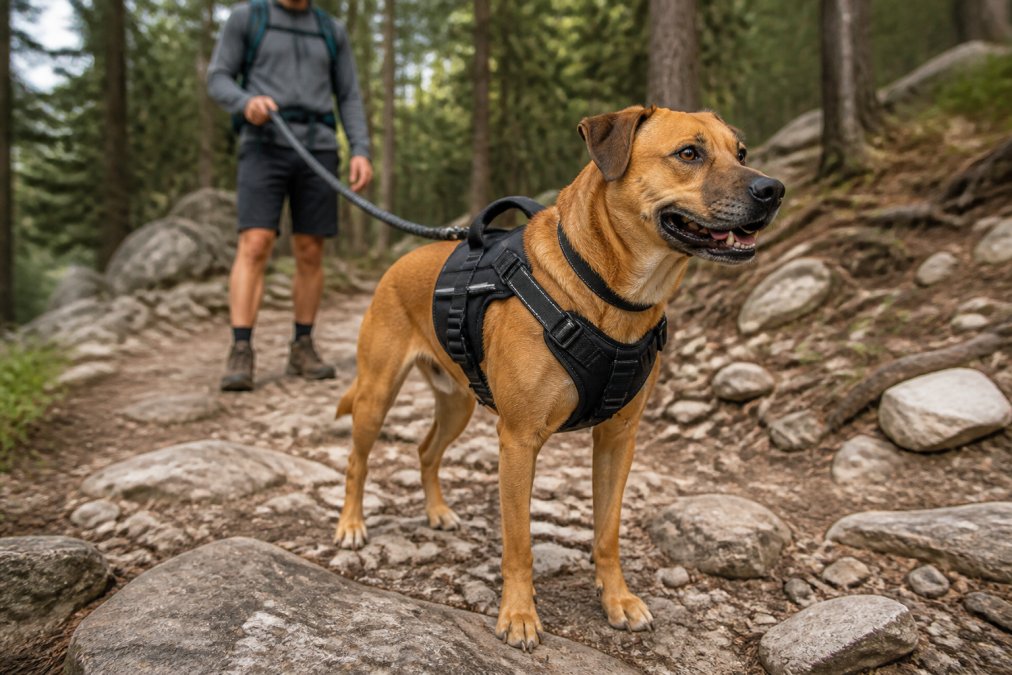
Priorities for trail use:
- Padded chest plate to spread pressure during steep descents
- Two attachment points, front and back, for a tangle-free leash setup
- Adjustable straps at the chest and belly for a secure fit on deep-chested dogs
- Reflective stitching so the harness reads at dusk
Fit check: two fingers should slide under every strap. Looser than that and a scrambling dog can back out of the harness on rugged terrain.
Travel Carriers and Safety Gear for Road Trips
A travel carrier only counts as safety gear if it stays put and holds its shape during a sudden stop. That is a structural problem, not a fabric problem, and it is where most soft-sided carriers fail.
How Crash Forces Actually Reach Your Pet
In a frontal impact, an unrestrained pet keeps moving at the vehicle's prior speed while the cabin stops. A 40-pound dog in a 30 mph crash generates a load on the carrier and restraint comparable to hundreds of pounds of static weight (nhtsa.gov). That load travels through the carrier's frame, the seatbelt or tether anchor, and the stitching at the attachment point, in that order. Whichever link is weakest defines the outcome.
This is why a soft-sided carrier with a thin wire frame and a single stitched loop is not crash protection. It is a container. The frame folds, the loop tears, and the pet becomes a projectile inside the cabin.
What to Look For in a Crash-Tested Carrier
- Rigid or semi-rigid frame that holds its shape when you press down on the top panel with both hands
- Seatbelt pass-through or tether strap that routes the belt across the carrier's center of mass, not across a handle
- Reinforced attachment stitching, bar-tack or box-X at every point where a strap meets the carrier body
- Metal or high-strength composite hardware at the tether connection, not molded plastic clips
- Crash-test documentation from the manufacturer, ideally tied to a recognized testing protocol rather than a marketing claim
A common pattern among buyers is to size the carrier to the pet and ignore the vehicle. The carrier has to fit the seat, the belt geometry, and the pet. Measure all three before ordering.
Crates vs. Carriers vs. Harnesses
| Restraint Type | Best For | Main Trade-Off |
|---|---|---|
| Crash-tested crate | Large dogs, daily travel | Bulk; hard to move between vehicles |
| Crash-tested carrier | Small and medium pets, air + car | Limited interior space |
| Crash-tested harness + tether | Dogs that resist confinement | Requires correct fit; not all harnesses are rated |
| Loose carrier or blanket | Nothing | Becomes a projectile |
A crash-tested harness tethered to a seatbelt anchor works well for dogs that panic in a crate, but only if the harness itself is rated for crash loads. A standard walking harness is not. The webbing and stitching are designed for pulling tension, not for absorbing a sudden deceleration.
Air Travel: Sizing and Cabin Rules
In-cabin pet dimensions vary by airline and by aircraft, and they change without much notice. Check the specific carrier's current pet policy for the exact route before buying, because a carrier that fits a regional jet may not fit a mainline cabin. Soft-sided carriers with flexible frames are usually easier to compress under a seat, but a flexible frame is the opposite of what you want in a car. Many owners end up owning two carriers for this reason.
Road Trip Kit That Earns Its Space
- Collapsible silicone bowl, packs flat, holds shape when filled
- Spill-resistant water bottle with a flip lid the pet can drink from directly
- Spare leash and a backup collar with current ID tags
- Absorbent seat cover or cargo liner with a non-slip backing
- Pet-safe first aid pouch, gauze, self-adhering wrap, tick removal tool, and a copy of vaccination records
- Cooling mat or frozen water bottle for hot-weather travel
Securing the Carrier in the Vehicle
Place the carrier on the rear seat, not the front. If the vehicle has LATCH anchors or a cargo tie-down system, use them. Route the seatbelt through the carrier's designated pass-through and pull it tight enough that the carrier shifts less than an inch when you push it side to side. A carrier that slides is a carrier that will rotate in a crash.
For crates, a ratcheting tie-down strap rated for cargo works better than a bungee cord. Bungees stretch under load, which is the opposite of what a restraint should do.
Visibility and Safety Accessories for Low-Light Adventures
Visibility gear is the cheapest safety upgrade you can make. Reflective stitching on a harness helps, but it only works when light hits it directly.
Add active lighting for dawn and dusk walks:
- LED collar or clip-on light with a rechargeable battery
- Reflective vest or band across the chest and back
- Lighted leash for hands-free walking on unlit paths
Bright colors alone don't make a pet visible to drivers.
Durable Pet Gear Maintenance Tips That Extend Lifespan
Cleaning Routines by Material Type
| Material | Cleaning Method | Frequency |
|---|---|---|
| Nylon webbing | Hand wash, mild soap, air dry | After muddy outings |
| Padded harness | Remove padding, rinse, air dry fully | Every 2-3 wears |
| Hard-shell carrier | Wipe down, disinfect interior | After each trip |
| LED gear | Damp cloth only, never submerge | Weekly |
When to Repair vs. Replace
Toys and Interactive Tools Built for High-Energy Pets
Breed-Specific Gear Needs Most Buyers Overlook
Gear by Activity, Not Just by Breed
Matching Harness Geometry to Build
Measure Before You Order
Conclusion
Frequently Asked Questions
What are the most durable materials for pet leashes and harnesses?
Look for nylon webbing rated for at least 1,000 pounds of pull strength, reinforced stitching at stress points, and metal hardware like aluminum or stainless steel instead of plastic. Water-repellent coatings help in wet conditions, and breathable mesh padding keeps the fit comfortable on long hikes. If the harness has reflective stitching, that adds visibility for evening walks without adding bulk.
How often should I replace my pet's active gear?
Check gear after every 10 to 15 outings. Replace a harness or leash immediately if you see frayed stitching, rusted hardware, or stretched webbing that no longer holds tension. Well-made durable pet gear can last one to three years with regular cleaning and storage, but any piece showing structural wear should go. Toys with cracks or missing pieces should be swapped out right away to avoid choking hazards.
How do I choose pet gear that can withstand outdoor adventures?
Start with the activity. Hiking demands heavy duty dog harnesses for hiking with padded chest plates and a handle for lifting over obstacles. Swimming calls for quick-release buckles that won't corrode. Running needs lightweight, non-slip designs. Match the material to the terrain: tear-resistant ripstop for brush, water-repellent coatings for creeks. Check that adjustability covers your dog's full girth range, since a loose fit rubs and a tight one restricts movement.
What are the best interactive toys for high-energy pets?
Recordable communication buttons keep dogs mentally engaged and can prevent physical inactivity during indoor days. Puzzle feeders and treat-dispensing balls work well for dogs that need problem-solving challenges. For cats, motion-activated toys and feather wands with durable construction hold attention longer than static toys. Rotate three or four toys weekly so novelty stays high, and inspect each one for cracks or loose parts before every session.