

Table of Contents
- Why Mindfulness Falls Apart When Life Gets Busy
- How to Incorporate Mindfulness Into Busy Schedules With Micro-Practices
- 5 Minute Mindfulness Activities for Overloaded Days
- Mindfulness Tools for Home That Support a Calm Routine
- How to Build a Mindfulness Habit That Actually Sticks
- Mindfulness for High-Pressure Moments and Decisions
- When Mindfulness Feels Like Another Task
- Your First Week: A Simple Plan to Start
- Frequently Asked Questions
Last Updated: September 4, 2026
Mindfulness is the practice of bringing present moment awareness to your daily life without judgment, and it does not require a meditation cushion or an empty hour to work. The most common misconception is that you need large blocks of time, which is exactly why most busy professionals abandon the habit within weeks. At ELTStores, we believe that a calm routine is built on small, repeatable actions rather than grand gestures. Below, we’ll show you exactly how to incorporate mindfulness into busy schedules using micro-practices, sensory awareness, and a few intentional tools.
Why Mindfulness Falls Apart When Life Gets Busy
The biggest mistake most guides make is treating mindfulness as an isolated activity rather than a way of moving through your existing day. When you frame it as a separate task, it competes with work deadlines, family obligations, and the mental clutter of your to-to list. The moment your calendar fills up, the first thing you drop is the "extra" activity.
The real problem is that we approach mindfulness with an all-or-nothing mindset. This binary thinking ignores the psychological mechanics of habit formation, where small wins create the neural pathway for larger behavioral change. For busy individuals, the solution is not finding more time, but rather embedding intentionality into the time you already have.
How to Incorporate Mindfulness Into Busy Schedules With Micro-Practices
Micro-practices are short, structured exercises that take between thirty seconds and two minutes, designed to interrupt the autopilot of your day. These techniques work because they lower the barrier to entry so drastically that skipping them feels more effortful than doing them.
The 5-4-3-2-1 Grounding Technique
This grounding exercise is a sensory awareness tool that pulls your mind away from anxious thoughts and anchors it in your physical environment. To practice it, pause wherever you are and silently note five things you can see, four things you can touch, three things you hear, two things you smell, and one thing you taste. This sequence forces your brain to shift from the default mode network, which handles rumination and worry, to the sensory processing regions, which only handle current input (the NIH).
Single-Tasking One Routine Task
Instead of trying to make your whole day mindful, choose one routine task and give it your full attention. This could be drinking your morning coffee, washing your hands, or walking from your car to the office. When you catch your mind drifting, gently guide your focus back to the physical sensations of the task. This practice builds self-regulation and trains your brain to notice when it has wandered, which is the foundational skill of all meditation. A common mistake is choosing a task that requires problem-solving, so pick something purely mechanical.
5 Minute Mindfulness Activities for Overloaded Days
When your schedule is completely saturated, a five-minute block can still deliver meaningful stress reduction and cognitive clarity. These activities are designed to be done anywhere.
- Box breathing: Inhale for four counts, hold for four, exhale for four, hold for four. Repeat for two minutes to regulate your nervous system.
- Body scan: Close your eyes and mentally move your attention from the top of your head down to your toes, noticing tension without trying to fix it.
- Mindful listening: Put on a piece of instrumental music and try to identify every individual instrument you can hear.
- Walking meditation: Walk slowly for five minutes, paying attention to the sensation of your feet hitting the ground and the rhythm of your stride.
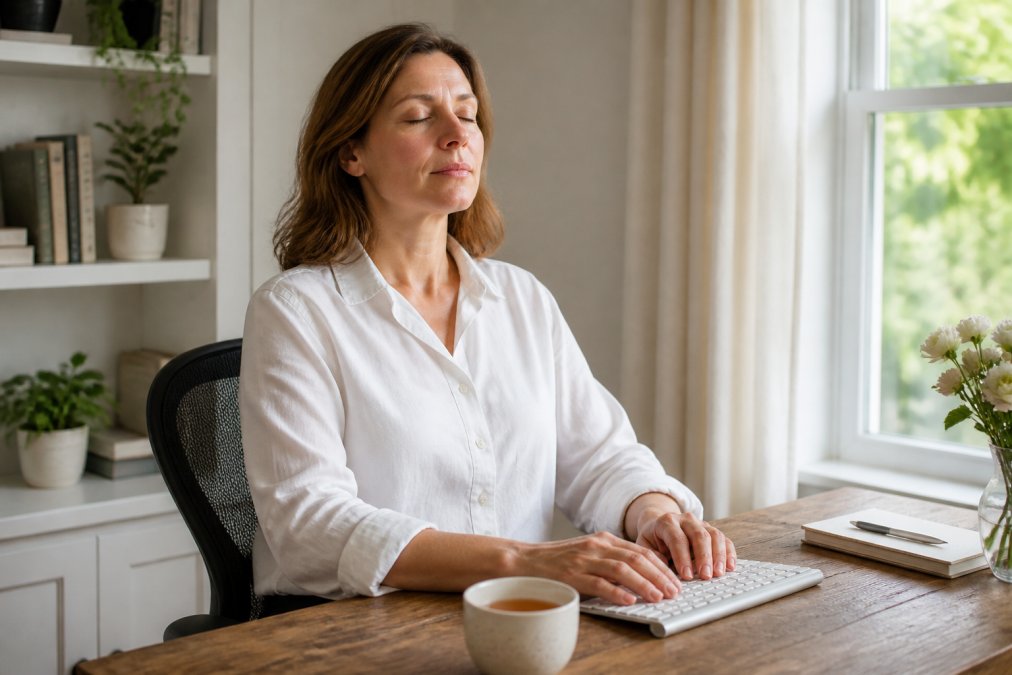
These short sessions are more effective than a single long one because they interrupt the accumulation of stress throughout the day. If you are working from home, these breaks also help delineate the boundary between professional and personal mental space.
Mindfulness Tools for Home That Support a Calm Routine
Your environment silently shapes your behavior, but for busy professionals, the most powerful tools aren't just candles and blankets, they're the devices already in your pocket. The unique challenge of a busy schedule is that your phone, the primary source of distraction, can also be your most consistent trigger for mindfulness.
Leveraging Existing Tech Without Adding Screen-Time Stress
The goal is to use your devices as a passive cue system, not an active app that demands your attention. Most practitioners find that a simple, non-visual alarm is more effective than a meditation app notification. Here’s how to set up a tech stack that works:
- Use Haptic Alarms on Your Smartwatch: Instead of a sound-based reminder, set a silent, vibrating alarm on your smartwatch for three specific times a day: mid-morning, post-lunch, and late afternoon. The physical buzz on your wrist is a discreet, private nudge to take one conscious breath. It interrupts the stress spiral without breaking your focus or alerting colleagues in a meeting.
- Repurpose Your Phone's 'Focus' Mode: Most smartphones have a built-in 'Focus' or 'Do Not Disturb' feature. Instead of just silencing notifications, customize a specific Focus mode (e.g., 'Deep Work') to only allow calls from your family. When you toggle this on, you're not just blocking distractions; you're making a conscious, physical act of setting an intention for the next 45 minutes. The act of toggling it becomes a mindfulness ritual in itself.
- The 'One-App' Rule for Mindful Eating: If you want to practice mindful eating, use your phone's timer app. Set it for 10 minutes before you start your meal. The timer ticking in the background serves as a boundary, encouraging you to slow down and savor each bite, rather than scrolling through social media. This turns a passive activity into a time-boxed, intentional practice.
The 'Transition Object' for Home and Office
For those working from home, the challenge is the blurred line between professional and personal space. A powerful tool is a physical 'transition object' that you use to bookend your workday.
- Choose a specific object: A particular mug, a small stone, or a dedicated notebook.
- At the start of your workday: Pick up the object and state your primary intention for the day out loud. For example, "My intention is to be fully present in my first meeting." Place it on your desk.
- At the end of your workday: Pick up the object again. This time, take three deep breaths and consciously acknowledge that your work is done. Move the object to a different location, like a shelf or a drawer in another room.
This physical act of moving an object creates a cognitive boundary that is more powerful than just closing your laptop. It signals to your brain that the 'office' is now closed.
A Note on Analog Cues
While tech is a powerful ally, don't underestimate the power of a strategically placed analog cue. The most effective ones are those that require a single, deliberate action. For example, a small hourglass timer on your desk that you flip over before a stressful call. Watching the sand fall for three minutes is a visual anchor that forces a pause. Similarly, a specific essential oil diffuser that you only turn on during your evening wind-down can create a powerful olfactory trigger for relaxation. The key is to choose tools that require you to do something, not just see something.
How to Build a Mindfulness Habit That Actually Sticks
Consistency is the single strongest predictor of whether mindfulness will deliver lasting benefits for stress management and well-being (apa.org). The standard advice is to 'habit stack', to attach a new practice to an existing routine. While that's a start, it fails for many busy professionals because it doesn't account for the cognitive load of a high-pressure day. To build a habit that sticks, you need a system that reduces the need for willpower and anticipates the moments when your routine breaks down.
The 'Implementation Intention' Upgrade
Instead of a vague plan like "I'll meditate after lunch," use the psychological framework of implementation intentions. This is a highly specific, if-then plan that offloads the decision-making to your environment. The formula is: "If [situation arises], then I will [tiny mindfulness action]."
- Weak Habit Stack: "After I sit at my desk, I will do a grounding exercise."
- Strong Implementation Intention: "If I sit at my desk and open my laptop before 9:00 AM, then I will close my eyes and take one slow breath before opening my email."
The second version is more effective because it includes a specific context (before 9:00 AM) and a clear trigger (opening the laptop). It forces your brain to recognize the exact moment of action, making the behavior more automatic.
Troubleshooting 'Mindfulness Fatigue' with the 'Minimum Viable Practice'
A common pain point for busy people is that mindfulness starts to feel like another item on the to-do list. This 'mindfulness fatigue' is a signal that you are treating the practice as a performance metric rather than a reset. When you feel this resistance, the most effective response is not to push through but to shrink the practice to its smallest possible size.
- The One-Breath Rule: If the thought of a 5-minute body scan feels exhausting, your only goal is to take one single, conscious breath. That's it. One inhale, one exhale, where your full attention is on the physical sensation of the air moving.
- The 'Glance' Technique: If even one breath feels like too much, simply glance out a window for three seconds and consciously notice a single color or shape. This is a micro-reset that prevents the habit from collapsing entirely.
- The 'Begin Again' Protocol: If you miss a day, or a week, the practice is not ruined. The research on stress management suggests that the ability to begin again without self-criticism is itself a core mindfulness skill. The moment you notice you've stopped practicing is itself a moment of mindfulness. Use that awareness to do your MVP right then, without judgment.
The 'Two-Minute Rule' for High-Pressure Days
On days when your schedule is packed with back-to-back meetings and decisions, your cognitive load is at its peak. This is not the time for a 20-minute session. This is the time for a two-minute 'executive reset' designed to restore cognitive function, not just reduce stress. This involves a specific sequence:
- Acknowledge the Load (10 seconds): Silently say to yourself, "I am feeling overwhelmed." This act of labeling your emotion has been shown to reduce activity in the amygdala, the brain's fear center (PubMed).
- Shift Attention (90 seconds): Focus on a single, neutral physical sensation. This could be the feeling of your feet on the floor or the weight of your hands on the desk. When your mind wanders to the next task, gently bring it back.
- Set a Single Intention (20 seconds): Ask yourself, "What is the one thing I need to accomplish in the next hour?" This re-establishes a sense of control and prioritization.
This two-minute protocol is designed to be done between meetings, not instead of them. It's a tool for cognitive recovery that allows you to perform at a higher level in the next high-pressure moment.
Mindfulness for High-Pressure Moments and Decisions
In high-stakes situations, your cognitive load spikes and your executive function narrows, making it difficult to see options clearly. Mindfulness here is not about relaxation; it is about creating a small gap between a stimulus and your response. Before you answer a difficult email, walk into a negotiation, or make a snap judgment, take one slow breath and ask yourself what outcome you actually want from this interaction.
This pause allows you to shift from a reactive, fight-or-flight state to a more measured, intentional response. Professionals who practice this report feeling less hijacked by their emotions and more capable of holding multiple perspectives. The practice of deep breathing before a decision is not about avoiding stress, but about ensuring that your stress does not make the decision for you.
When Mindfulness Feels Like Another Task
There will be days when the thought of being mindful feels like just another obligation on your list, and this is a signal that you are treating the practice as a performance rather than a reset. This "mindfulness fatigue" usually happens when you attach achievement metrics to the practice, like counting consecutive days or forcing yourself to feel calm. If you notice this resistance, the most effective response is to shrink the practice to its smallest possible size.
The goal is not to be mindful every moment, but to return to the present moment more often. If you miss a day, or a week, the practice is not ruined. The research on stress management suggests that the ability to begin again without self-criticism is itself a core mindfulness skill.
Your First Week: A Simple Plan to Start
To avoid overwhelm, structure your first week with a clear, simple plan that focuses on repetition over intensity. The table below outlines a starting schedule that uses habit stacking and short sessions to build momentum.
| Day | Time Anchor | Micro-Practice | Duration |
|---|---|---|---|
| Day 1-2 | After morning coffee | 5-4-3-2-1 grounding | 1 minute |
| Day 3-4 | Before lunch | Single-tasking your first bite | 3 minutes |
| Day 5-6 | After work commute | Box breathing | 2 minutes |
| Day 7 | Any time | Body scan before bed | 5 minutes |
Treat this week as an experiment, not a test. Notice how you feel after each session, and adjust the time anchor if it does not fit your natural rhythm. The most effective mindfulness practice is the one you will actually repeat, and a short daily ritual will always outperform a longer one you avoid.
Frequently Asked Questions
How can I incorporate mindfulness into my daily routine when I have no time?
Start with micro-practices that attach to things you already do. Pair a single deep breath with the moment you pour your morning coffee or wash your hands. Use the 5-4-3-2-1 grounding method during a commute or before a meeting. These take under two minutes and do not require extra blocks of time. The goal is to build a mindfulness habit through repetition, not duration.
What are the 5-4-3-2-1 mindfulness activities?
The 5-4-3-2-1 technique is a grounding exercise that uses your senses to bring you into the present moment. Name five things you can see, four you can touch, three you can hear, two you can smell, and one you can taste. It works well for stress reduction in high-pressure moments because it shifts attention away from mental clutter and toward your immediate surroundings.
What are the three C's of mindfulness?
The three C's are a simple framework for staying present: Curiosity, Compassion, and Calm. Approach each moment with curiosity about what you notice, extend compassion to yourself when your mind wanders, and return to a calm, steady breath. This structure helps busy professionals practice self-regulation without needing a long meditation session.
How do I practice mindfulness in under 5 minutes at home?
Choose one routine task and do it with full attention. Wash dishes and notice the water temperature and the texture of the soap. Fold laundry and observe the fabric and the motion of your hands. Alternatively, set a timer for three minutes and follow your breath. These 5 minute mindfulness activities reduce stress and improve focus without disrupting your schedule.
Building a sustainable mindfulness practice requires patience and the right environment to support your intention. At ELTStores, we curate products that create space for rest and reflection, from comfort objects for your designated calm corner to tools that invite you to slow down. Get started with ELTStores and transform your busy schedule into a series of gentle, mindful pauses.
This article was written using GrandRanker