

Table of Contents
- Smart Gadgets That Simplify Daily Life: Your Essential Guide
- Best Smart Home Devices for Beginners
- How to Automate Daily Routines With Smart Tech
- Advanced Smart Gadgets for Convenience and Security
- Specialized Smart Gadgets for Travel and Daily Wellness
- Privacy, Interoperability, and Smart Ecosystem Integration
- Budget-Friendly vs. Premium Smart Gadgets: Finding Your ROI
- Frequently Asked Questions
Last Updated: September 2, 2026
Smart Gadgets That Simplify Daily Life: Your Essential Guide
Smart gadgets have moved beyond novelty into genuine necessity. The question isn't whether to adopt smart technology, but which devices actually deliver on their promises.
At ELTStores, we've curated lifestyle products that genuinely integrate into daily routines. This guide walks through smart gadgets worth your attention, from entry-level devices costing less than dinner out to premium tools that transform how you manage your home and travel.
The best smart gadgets solve real problems: they save time, reduce friction, and create space for what matters. We'll show you which ones do.
Best Smart Home Devices for Beginners
Starting with smart home automation doesn't require massive investment or technical expertise. Entry-level devices deliver immediate, visible results without complexity.
Smart Speakers and Voice Assistants
A smart speaker is the foundation of most home automation setups. It's your voice-controlled hub for information, entertainment, and device control.
The Amazon Echo Dot (5th Gen) at $49.99 is a practical starting point. It includes a temperature sensor that triggers smart home routines automatically, improved audio, and functions as a mesh Wi-Fi extender. Setup takes under five minutes. Alexa understands natural speech patterns, say "I'm going to bed" and it triggers multiple devices at once: lights off, doors locked, thermostat adjusted.
The Google Nest Mini offers an alternative at the same $49.99 price point. It integrates seamlessly with Google services and prioritizes privacy slightly more than Amazon's ecosystem. The tradeoff: fewer third-party integrations than Alexa.
Both work without subscription, though premium features require optional paid services. For beginners, the free tier covers 95% of actual use cases.
Smart Plugs and Power Management
Smart plugs are the most underrated entry point into automation. They're cheap, require zero installation, and work with nearly everything.
The Kasa Smart Plug Mini (KP115) costs $9.99 per unit and lets you control any plugged-in device remotely while monitoring energy consumption in real time. Plug in a lamp, coffee maker, fan, or space heater, and suddenly you can turn it on or off from your phone, schedule activation at specific times, and check electricity usage. The compact design means two plugs fit side-by-side on a standard outlet.
Setup is straightforward: download the Kasa app, plug it in, scan the QR code. No hub required. It works with Alexa and Google Assistant for voice commands.
One limitation: requires a 2.4GHz Wi-Fi network. If your router only broadcasts 5GHz, you'll need to enable the older standard.
Smart Lighting and Ambiance Control
Smart lighting transforms how a space feels without requiring an electrician. The Philips Hue White and Color Ambiance A19 Starter Kit at $199.95 includes two color-changing bulbs plus the Hue Bridge, which enables advanced features.
You control 16 million colors and precise white light temperatures from your phone. Create scenes: "Movie Mode" dims lights to 10% and shifts to warm red. "Morning Energize" gradually brightens to cool white over 30 minutes. The Hue Bridge unlocks scheduling, automation based on time or location, and remote control even when away from home.
LED bulbs use 80% less electricity than incandescent ones and last 25,000+ hours (energy.gov). If you replace four bulbs, energy savings pay for the system within a year or two.
How to Automate Daily Routines With Smart Tech
Automation shifts smart gadgets from convenient to genuinely life-changing by removing friction from routines you already do.
Start by identifying routines you repeat: morning wake-up, leaving for work, arriving home, bedtime. Each can be automated with smart devices responding to triggers.
Morning routine: Set your smart speaker to gradually brighten lights at 6:30 AM and play your favorite news briefing. Have your smart plug turn on the coffee maker five minutes before you wake up.
Leaving home: Create a scene that turns off all lights, locks smart doors, and adjusts the thermostat to save energy. Trigger it with a single voice command or automatically when the last person leaves.
Arriving home: Lights turn on to 40% brightness, the front door unlocks automatically, and the thermostat adjusts to your preferred temperature.
Bedtime: All lights off except a dim path light to the bathroom. Doors locked. Thermostat drops two degrees for better sleep. One voice command handles everything.
Start simple, then expand. Most people overestimate how much automation they'll use and underestimate how much they'll appreciate small conveniences. A single automated routine that saves five minutes daily adds up to 30 hours per year.
Advanced Smart Gadgets for Convenience and Security
Once you've mastered basic automation, the next tier handles larger problems: cleaning, security, and access control.
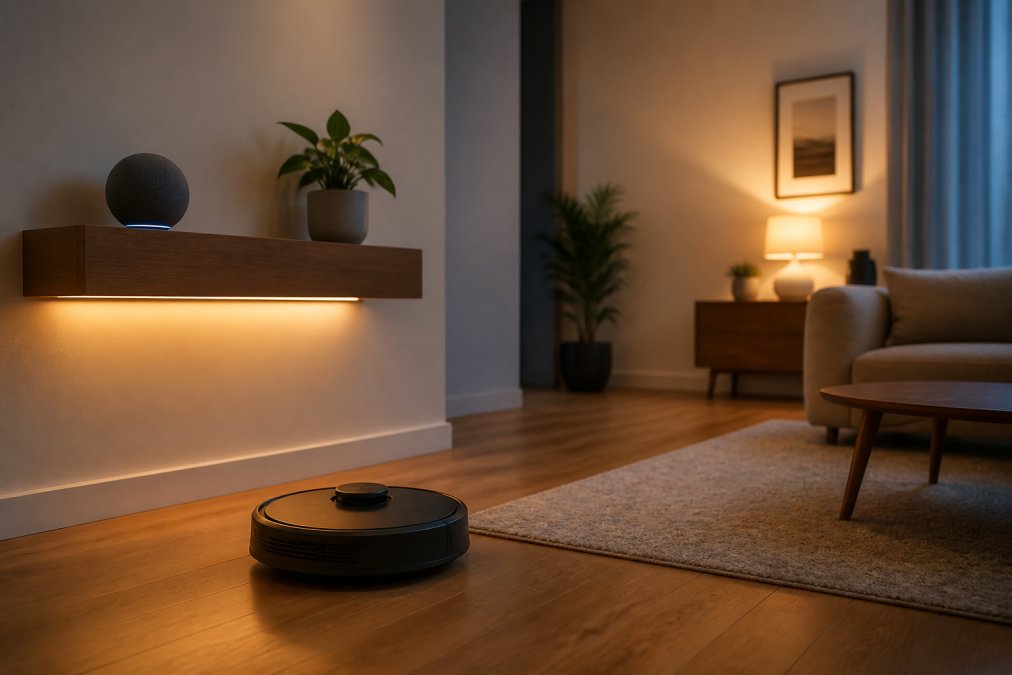
Robotic Vacuums for Automated Cleaning
Robotic vacuums have evolved from gimmicks into genuinely practical tools, especially for pet owners and people with mobility challenges.
The iRobot Roomba j7+ at $649.99 uses AI to navigate your home and avoid obstacles, including pet waste, which the system explicitly guarantees to avoid (irobot.com). The self-emptying base is the real convenience feature, after each cleaning cycle, the vacuum returns to its dock and empties its dustbin automatically. You don't touch dirt for months.
Smart mapping lets you tell the vacuum to clean only specific rooms. Set schedules so it runs while you're at work. The app shows real-time progress and cleaning history.
The tradeoff: it's expensive, and the self-emptying base adds another $200-300. It's also loud during operation. For apartments or homes without pets, a basic robot vacuum costs half as much.
Video Doorbells and Home Security
A video doorbell is one of the few smart home devices that pays for itself through peace of mind alone.
The Wyze Cam v3 costs only $35.98 for 1080p HD video, color night vision, and weather-resistant design. It mounts with magnetic attachment, screws, or standard mount. You see who's at your door before opening it. Packages are visible. Suspicious activity gets recorded. You can talk to visitors through the camera's speaker even when away.
Setup requires a microSD card for local storage. The camera itself is extremely affordable, but optional Cam Plus subscription adds cost for continuous recording and cloud backup.
Smart Locks and Access Control
Smart locks eliminate carrying physical keys and let you grant temporary access remotely.
The August Wi-Fi Smart Lock at $229.99 retrofits onto your existing deadbolt with no door modification. It includes built-in Wi-Fi for direct remote access, auto-lock and auto-unlock based on your phone's location, and virtual guest keys with time limits.
The activity log shows every entry and exit with timestamps. Battery life is 3-6 months between charges depending on usage. The lock integrates with major smart home ecosystems for automation routines.
Specialized Smart Gadgets for Travel and Daily Wellness
Beyond the home, smart gadgets solve specific problems for travelers and people prioritizing wellness.
AI Translation Earbuds for Travelers
The Timekettle WT2 Edge AI Translation Earbuds support 40 languages and 93 accents with both online and offline translation modes.
These earbuds enable bi-directional conversation: you speak in English, they translate to Mandarin, the other person responds in Mandarin, and you hear English. Offline mode works for 8 languages, critical if visiting countries with spotty Wi-Fi.
At $249.00, the price is high, but for frequent international travelers, the ability to have real conversations without a translator is transformative. Accuracy varies in noisy environments, but the technology is improving rapidly.
Smart Temperature Control Devices
The Ember Temperature Control Smart Mug 2 keeps your beverage at your exact preferred temperature for hours. Set it to 130°F and it maintains that temperature whether actively drinking or stepping away.
Coffee stays perfect from first sip to last. Tea never cools to that unpleasant lukewarm state. The battery lasts 80 minutes off the charging coaster, or indefinitely when placed on it.
At $109.95, it's expensive for a mug, but if you take hours to finish a beverage or constantly reheat drinks, the convenience is real. The tradeoff: you need the charging coaster for all-day use, limiting travel utility.
Privacy, Interoperability, and Smart Ecosystem Integration
The best smart gadgets work together seamlessly. This requires understanding interoperability and data privacy.
Interoperability means devices from different manufacturers communicate with each other. The Matter standard and Thread wireless protocol are emerging as universal bridges. Devices supporting Matter work together regardless of brand, preventing vendor lock-in.
Privacy is the tradeoff with smart home convenience. These devices collect data: when you're home, your routines, your preferences, your location. Before buying, check the manufacturer's privacy policy. Does the company encrypt data? Do they sell your information? Can you delete your data?
ELTStores offers a curated selection of lifestyle products designed to elevate your everyday rituals and bring comfort into your home. Our collection focuses on inviting objects that create space for rest, reflection, and gentle joy.
Budget-Friendly vs. Premium Smart Gadgets: Finding Your ROI
Smart gadgets range from $10 smart plugs to $650+ robot vacuums. The question isn't which is "better", but which delivers value for your situation.
Budget-friendly approach ($50-150 total):
- Smart speaker (Echo Dot or Nest Mini): $49.99
- 2-3 smart plugs: $20-30
- Basic smart bulbs: $30-50
This setup handles basic automation and lets you experiment with what you actually use.
Mid-range approach ($300-500):
- Smart speaker: $50
- Smart lighting system with bridge: $200
- Smart plugs and basic security camera: $50-150
- Smart lock: $230
This level handles comprehensive home automation, security monitoring, and access control.
Premium approach ($800+):
- Complete smart lighting ecosystem: $200+
- Robot vacuum with self-emptying: $650+
- Video doorbell and security system: $100-200
- Smart lock: $230+
- Additional devices: $200+
The ROI calculation is personal. A $250 smart lock saves you the cost of a locksmith visit when locked out. A $650 robot vacuum saves 5-10 hours monthly if you have pets and a large home. A $50 smart speaker saves time on daily information retrieval.
Start with budget-friendly devices, measure how much you actually use them, then invest in premium options that solve real problems.
| Device Category | Budget Option | Starting Price | Premium Option | Starting Price | Best For |
|---|---|---|---|---|---|
| Smart Speaker | Echo Dot | $49.99 | Echo Show | $99.99+ | Voice control and automation |
| Smart Lighting | Basic smart bulbs | $15-25 each | Philips Hue system | $199.95 | Ambiance and scheduling |
| Power Management | Kasa Smart Plug | $9.99 | Smart power strip | $50-70 | Device automation |
| Cleaning | Basic robot vacuum | $200-300 | Roomba j7+ | $649.99+ | Pet owners, large homes |
| Security | Wyze Cam | $35.98 | Premium doorbell | $200+ | Monitoring and deterrence |
| Access Control | Smart lock | $150-230 | Premium smart lock | $300+ | Keyless entry, guest access |
The most satisfying smart gadgets are the ones you actually use every day. They don't need to be expensive or complicated. A $50 smart speaker that answers questions and controls lights delivers more real value than a $500 device gathering dust.
ELTStores curates products that genuinely integrate into daily routines and create space for rest, reflection, and gentle joy. Start with one device that solves a real problem. If it works, expand from there.
Shop now at ELTStores and discover the smart gadgets that align with how you actually live.
Frequently Asked Questions
Q: What are the best smart gadgets to simplify daily life for beginners?
A: Start with a smart speaker like the Amazon Echo Dot or Google Nest Mini ($49.99 each), smart plugs for appliance control, and smart lighting bulbs. These devices offer voice-activated convenience, hands-free control, and real-time monitoring without requiring complex setup. They form the foundation of a smart home ecosystem and work independently if you decide not to expand later.
Q: How do I automate daily routines with smart tech?
A: Use your smart speaker to create routines that trigger multiple devices simultaneously. For example, say 'Good morning' to turn on lights, start your coffee maker via smart plugs, and hear the weather forecast. Smart scheduling through apps lets you set recurring automation: lights dim at sunset, thermostats adjust at bedtime, and robotic vacuums clean on specific days. Start with 2-3 routines and expand as you become comfortable.
Q: Are smart gadgets really worth the investment?
A: Budget-friendly options like smart plugs ($9.99) and basic smart speakers offer immediate convenience and energy monitoring without large upfront costs. Premium devices like robotic vacuums or smart locks cost more but save significant time and effort over years of use. Calculate your ROI based on time saved and energy reduced, not just the purchase price. Many people find even affordable gadgets worthwhile for the convenience alone.
Q: How do I ensure my smart gadgets work together safely?
A: Look for devices that support Matter or Thread protocols for reliable interoperability across different brands. Check privacy policies and ensure your Wi-Fi network uses strong passwords. Start with devices from established manufacturers that provide regular security updates. Keep firmware current and use two-factor authentication on connected apps. Privacy-conscious users should review what data each device collects before purchase.
Q: What smart gadgets are best for travelers and international professionals?
A: AI translation earbuds like the Timekettle WT2 Edge support 40 languages and 93 accents, enabling real-time conversations abroad. They work in online and offline modes, essential when international connectivity is unreliable. These devices are particularly valuable for business professionals attending meetings across language barriers and frequent travelers seeking authentic local interactions without constant translation app switching.
This article was written using GrandRanker