

Table of Contents
- What Mindful Shoppers Should Compare Before Switching
- Best Mindful Lifestyle Products for Busy Professionals
- How to Build a Mindful Morning Routine
- Conscious Consumerism Tips for Budget-Conscious Shoppers
- How to Evaluate a Wholifeco Alternative for Your Home
- Conclusion
- Frequently Asked Questions
Last Updated: September 16, 2026
What Mindful Shoppers Should Compare Before Switching
A wholifeco alternative is a curated home and lifestyle retailer that matches the promise of calm, intentional living while offering clearer ingredient transparency, verifiable ethical sourcing, and products that hold up to daily use. This guide from ELTStores breaks down what to compare before you switch, and which items are worth the shelf space in 2026.
Ingredient Transparency and Ethical Sourcing
Ingredient transparency means a retailer tells you exactly what a product is made of and where the materials came from, without forcing you to email customer service. For textile and home goods, that means fiber content, dye type, and country of manufacture on the product page.
Sustainability Metrics That Actually Matter
Sustainability metrics that matter are measurable, not aspirational: packaging weight, recycled content percentage, product lifespan, and shipping distance all count. A "carbon neutral" badge you can't trace to a methodology is marketing, not a metric.
Three questions cut through most green claims:
- What percentage of the packaging is recycled or recyclable?
- How long is the product designed to last?
- Is the material source disclosed by name or region?
Best Mindful Lifestyle Products for Busy Professionals
The best mindful lifestyle products for busy professionals earn their place in a small apartment or a packed carry-on. Three items from ELTStores cover sleep, atmosphere, and light, each solving a specific problem rather than adding clutter.
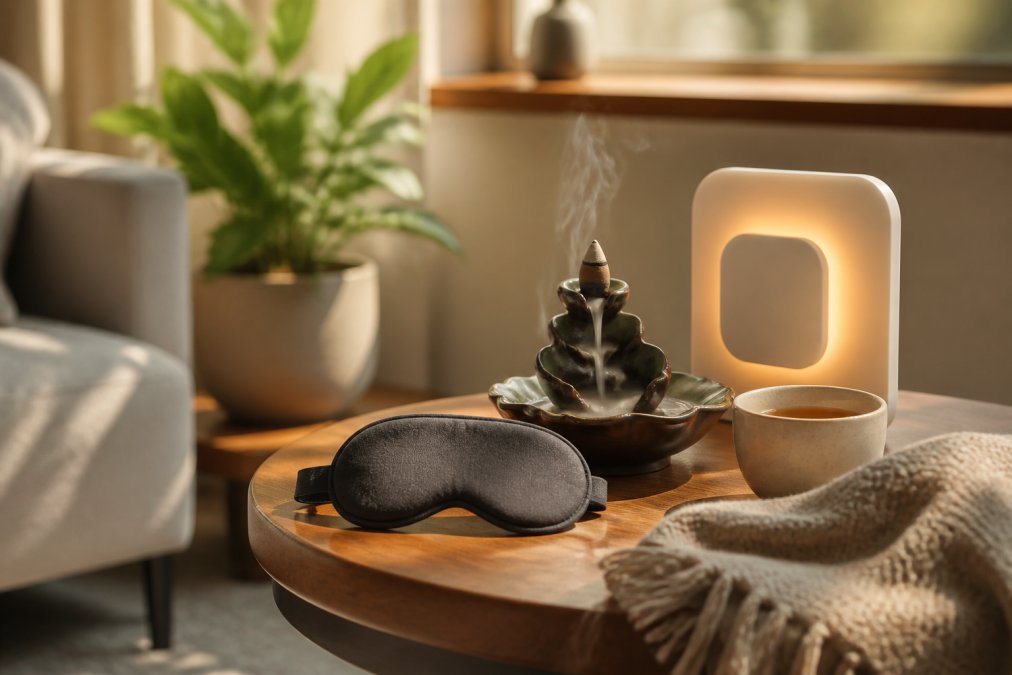
Memory Foam Eye Mask: $28.13
The Memory Foam Eye Mask is the most useful item for anyone who travels or shares a bedroom with a different sleep schedule. Soft memory foam contours to your face for a pressure-free fit, and the shape works for people with long lashes. It blocks light completely, packs flat, and comes in black, gray, and pink.
Purple Sand Ceramic Backflow Incense Burner (Large): $68.99
Handcrafted from purple clay pottery, this burner produces backflow smoke that cascades like a waterfall, and it's built for agarwood and sandalwood incense. The landscape and floral patterns make it a display piece as much as a functional one.
LED Color-Changing Wall Light: $50.21
The LED Color-Changing Wall Light cycles through seven colors (red, green, blue, yellow, purple, cyan, and white) on a slow transition, or holds one color via the smart remote. It installs concealed or surface-mounted, with openings of 5-9 cm, and uses American Bridgelux LED chips.
| Product | Price | Best For | Key Feature |
|---|---|---|---|
| Memory Foam Eye Mask | $28.13 | Travel and light sleepers | Contoured, light-blocking fit |
| Purple Sand Ceramic Backflow Incense Burner (Large) | $68.99 | Meditation corners | Handcrafted purple clay pottery |
| LED Color-Changing Wall Light | $50.21 | Hallways and foyers | Seven-color slow transition |
How to Build a Mindful Morning Routine
A mindful morning routine is a fixed sequence of three or four small actions you repeat before checking your phone. The goal isn't a longer routine but a predictable one, and, for a mindful shopper, a routine you can audit like a product page.
Step 1: Light Before Screens
Start with light. A slow color transition from an LED wall light gives your eyes a gentler wake-up than an overhead fixture at full brightness.
Step 2: Scent as an Anchor
Then add scent. A sandalwood cone in a backflow burner takes about a minute to set up and anchors the first ten minutes of the day. The anchor is the point, a repeated smell at the same time each morning makes the routine stick, not the scent itself.
Step 3: One Physical Action
Finish with one small physical task: stretching, writing a line in a notebook, or grooming a pet. The Pet Grooming Gloves ($23.93) fit because the action is short, tactile, and tied to something you already do. A routine that borrows an existing habit survives longer than one that adds an obligation.
The Audit: Is Each Object Earning Its Place?
This is the step no competitor covers. Run your routine objects through the same four tests you'd run on any store:
| Routine Object | Cost | Uses Per Week | Cost Per Use (Year 1) | Verdict |
|---|---|---|---|---|
| Memory Foam Eye Mask | $28.13 | 7 | ~$0.08 | Keep if you sleep poorly |
| Backflow Incense Burner | $68.99 | 5 | ~$0.27 | Keep if scent anchors you |
| LED Color-Changing Wall Light | $50.21 | 7 | ~$0.14 | Keep if it replaces an alarm-light |
| Pet Grooming Gloves | $23.93 | 3 | ~$0.15 | Keep if you already groom weekly |
What Breaks a Routine
Keep the sequence short enough that a late night or early flight doesn't break it. Three steps you actually do beat seven you abandon by Wednesday.

Conscious Consumerism Tips for Budget-Conscious Shoppers
Conscious consumerism tips work best when they reduce total spending rather than redirect it. The cheapest sustainable purchase is often the one you don't have to replace.
The Value-vs-Quality Matrix
Cost per year = Sticker price ÷ Expected years of use
Run it against the products in this guide:
| Product | Price | Expected Lifespan | Cost Per Year | Cheaper Substitute | Substitute Cost Per Year | Winner |
|---|---|---|---|---|---|---|
| Memory Foam Eye Mask | $28.13 | 3 years | ~$9.38 | $9 mask, replaced 2x/year | ~$18.00 | Quality |
| Backflow Incense Burner | $68.99 | 5+ years (ceramic) | ~$13.80 | $15 burner, replaced yearly | ~$15.00 | Quality (marginal) |
| LED Wall Light | $50.21 | 5+ years (LED rated) | ~$10.04 | $12 strip light, replaced yearly | ~$12.00 | Quality (marginal) |
| Pet Grooming Gloves | $23.93 | 2 years | ~$11.97 | $6 brush, replaced yearly | ~$6.00 | Substitute |
Price Per Ounce and Price Per Unit
For consumables, incense, tea, oils, refills, sticker price is nearly meaningless. Compare price per ounce or per cone instead. A $12 box of 50 cones is $0.24 per cone; a $20 box of 120 cones is $0.17 per cone. The larger box may offer a better unit cost, but it's important to consider if you'll use the full quantity before it loses potency.

The 30-Day Wait List
A practical approach many shoppers use:
- Set a 30-day wait list for any non-essential item over $50
- Check whether the product page lists materials and country of manufacture
- Compare cost per year of expected use, not sticker price
- Buy the version you'll keep, not the version you'll upgrade
A $28.13 eye mask used for three years can offer a lower cost per night than a $9 mask replaced twice a year. Considering cost per year can align budget-conscious and quality shopping.
Where Budget Shoppers Get Burned
Three patterns show up again and again:
- Chasing the lowest sticker price on durables. The cheapest version of a durable good is almost never the cheapest per year.
- Overbuying consumables. Bulk pricing only wins if you finish the product.
- Ignoring return policy as a quality signal. A generous return window often means the seller expects the product to last, or expects you to be unhappy.
Consumer Reports guidance on evaluating product durability recommends checking warranty terms and return policies before purchase, since a generous return window is often a signal that the seller expects the product to last.
How to Evaluate a Wholifeco Alternative for Your Home
Evaluating a wholifeco alternative comes down to four tests: material disclosure, sourcing specifics, durability signals, and fit with a routine you already have.
Run this checklist against any store before you commit:
| Criteria | What to Look For | Red Flag |
|---|---|---|
| Material disclosure | Full material list on the product page | "Eco-friendly" with no specifics |
| Ethical sourcing | Named facility or region | No sourcing info at all |
| Durability | Warranty, care instructions, lifespan | No care guidance |
| Routine fit | Solves a problem you have weekly | Purely decorative |
Conclusion
The hardest part of switching retailers isn't finding a better aesthetic. It's finding one where product pages tell you what you're actually buying, and where items hold up long enough to justify the switch.
Frequently Asked Questions
What should I look for when choosing a wholifeco alternative?
Focus on four things: ingredient and material transparency, ethical sourcing claims you can verify, real pricing with no hidden markups, and whether the catalog matches your actual daily routines. A good wholifeco alternative names its materials, shows product dimensions in metric, and prices items individually so you can budget. Look for small-batch or handcrafted items with clear descriptions, and check that the store ships promptly rather than listing products it cannot fulfill.
How do I choose ethical brands for home and wellness products?
Start with the product listing itself. Ethical brands disclose materials, country of origin, and whether items are handcrafted or mass-produced. For home goods, check for natural materials like walnut wood or ceramic, and for wellness items, look for clear use instructions. Avoid vague claims like 'sustainable' without specifics. A store that explains its sourcing, offers gift packaging, and prices fairly tends to be more trustworthy than one relying on aesthetic marketing alone.
Are there affordable mindful lifestyle products for busy professionals?
Yes. Mindful living does not require high spending. Small, functional items under $30 can anchor a routine: a memory foam eye mask at $28.13 improves sleep on flights and at home, while pet grooming gloves at $23.93 turn shedding season into bonding time. Pair one or two purchases with consistent habits, like a five-minute morning stretch, and you get the benefit without a full home overhaul.
What defines a mindful shopping experience?
A mindful shopping experience means buying with intention rather than impulse. That includes knowing why you want an item, checking that it fits an existing routine, and choosing stores that are transparent about materials and pricing. It also means fewer, better purchases. For example, a handcrafted ceramic incense burner at $68.99 that you use weekly offers more value than three decorative items you never touch. Slow down, read listings fully, and buy once.