

Table of Contents
- What Makes Interactive Toys Durable for Active Cats
- Best Interactive Toys for Indoor Cats: 5 Durable Picks
- How to Keep an Indoor Cat Entertained with Interactive Play
- Cat Toy Safety Standards: What to Check Before You Buy
- Noise Levels and Age-Specific Durability for Indoor Play
- Repair and Maintenance Tips for Long-Lasting Cat Toys
- Frequently Asked Questions
Last Updated: September 19, 2026
What Makes Interactive Toys Durable for Active Cats
Durable interactive toys for active cats survive repeated pouncing, biting, and batting through reinforced stitching, non-toxic components, and construction built for daily play.
- Reinforced seams and joints that resist tearing under repeated biting
- Cat-safe plastics and natural fibers that won't crack or shed
- Weighted or anchored bases that stay put during aggressive batting
Best Interactive Toys for Indoor Cats: 5 Durable Picks
The best interactive toys for indoor cats balance durability with engagement. Here are five picks: two ELTStores favorites and three categories worth exploring.
Remote Control Flying Fish
The Remote Control Flying Fish turns a living room into a hunt zone. Helium-filled, it glides up to 40 feet with 360-degree movement and tail sway that triggers prey drive.

4 Colors Pet Communication Button
The 4 Colors Pet Communication Button is a recordable button that teaches your cat to "ask" for play, treats, or attention with one press.

Food Puzzle and Treat-Dispensing Toys
Food puzzles turn mealtime into a hunt: your cat paws, rolls, or nudges the toy to release kibble, satisfying prey drive and slowing eating. Look for adjustable difficulty so the puzzle grows with your cat's skill.
Electronic and Motion-Activated Toys
Motion-activated toys that skitter, spin, or dart mimic prey without you holding a string. The trade-off is noise and battery life, choose models with a low hum, since loud motors spook indoor cats.
Suction-Cup Wand Toys
Suction-cup toys stick to hard floors or windows for solo play, but the base is the weak point. Check that the cup is thick rubber, not thin vinyl, or it'll pop off mid-pounce.
| Toy Type | Best For | Durability Strength | Watch Out For |
|---|---|---|---|
| Remote Control Flying Fish | Full-room chase | Durable nylon shell | Needs helium refills |
| Communication Button | Mental stimulation | ABS plastic | Requires training |
| Food Puzzles | Slow feeding, solo play | Varies by brand | Adjustable difficulty needed |
| Motion-Activated | Independent play | Motor housing | Noise sensitivity |
| Suction-Cup Wands | Window/floor solo play | Rubber base | Weak suction cups |
How to Keep an Indoor Cat Entertained with Interactive Play
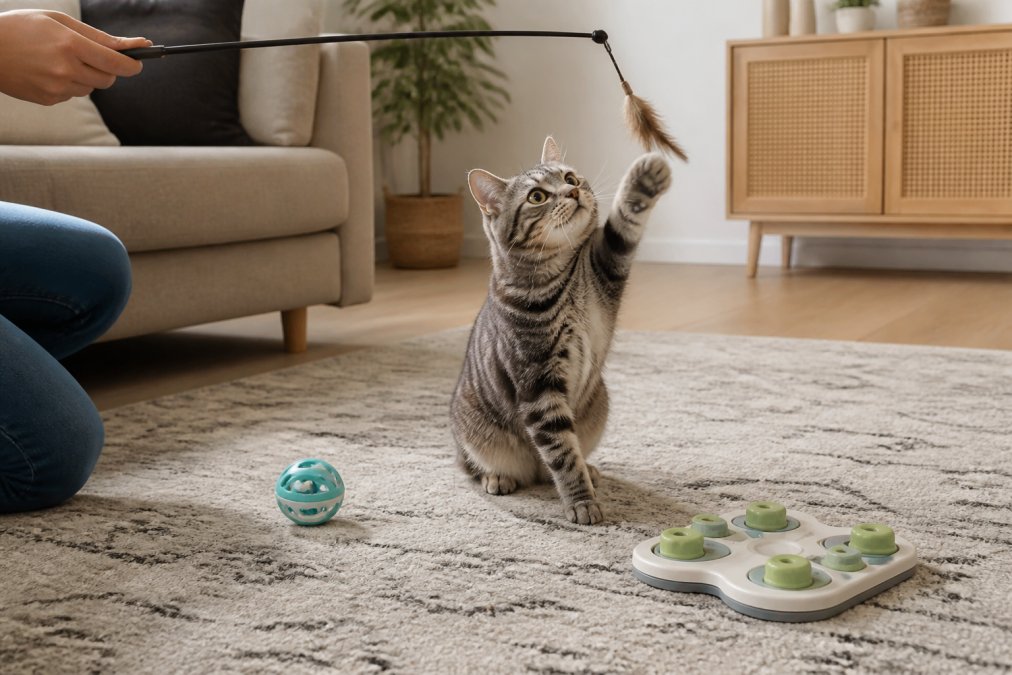
Keeping an indoor cat entertained comes down to variety, timing, and matching the toy's durability class to your cat's play style, not buying more toys. Cats lose interest in the same toy used the same way, so rotate options and play at their energy peaks.
Match the Toy to the Energy Window
Cats are crepuscular, peaking at dawn and dusk. Structure play around those windows:
- Chase phase (3-5 minutes): a wand toy with a reinforced seam and a swivel clip, so the line doesn't twist and snap mid-pounce.
- Catch-and-eat phase (5-8 minutes): a food puzzle or treat-dispensing ball loaded with a measured portion of their daily kibble, not extra calories. This is where the prey sequence completes, which is what actually reduces boredom behaviors.
- Wind-down phase (2-3 minutes): a low-motion toy, like a plush kicker or a slow-rolling ball, so the session ends on a calm note rather than a spike.
The Durability Rotation Trick
Most owners rotate toys by type. Better to rotate by durability class, since active cats destroy toys in a predictable order:
- Class 1 (soft fabric): wand attachments, plush kickers, crinkle toys. These fail first, usually at the seam where the attachment meets the wand or where the kicker's belly seam takes the bite load. Inspect after every session.
- Class 2 (semi-rigid): rubber balls, treat dispensers, suction-cup wands. These fail at the joint, the suction cup, the dispenser lid, the clip.
- Class 3 (hard-shell): ABS-plastic buttons, motorized mice, remote-controlled toys. These fail at the battery compartment or the motor housing, usually from moisture or a dropped unit.
Independent Play vs. Interactive Play
Interactive play, you holding the wand or tossing the ball, builds the bond and controls intensity. Independent play, suction-cup wands, motion-activated mice, food puzzles, covers the hours you're at work or asleep.
Age-Specific Play Adjustments
A toy that suits a bold two-year-old may terrify a senior cat. Adjust the plan as your cat ages:
- Under three years: high-intensity, high-durability toys. Reinforced fabric and solid plastic housings handle constant attacks best. Expect to replace soft toys every 4-8 weeks.
- Three to eight years: predictable toys with moderate motion. This is the sweet spot for electronic and motion-activated toys, since the cat still chases but with less destructive force.
- Senior cats (eight-plus): soft, textured toys and low-noise electronics. Joint stiffness makes hard landings and fast pivots uncomfortable, so favor slow-rolling balls and floor-level puzzles over airborne toys.
Cat Toy Safety Standards: What to Check Before You Buy
Cat toy safety standards in the United States are largely voluntary, so inspecting what you bring home falls on you. There's no federal certification for pet toys like there is for children's products, which is why material choice matters more than any label.
Who Actually Regulates Pet Toys
Three bodies matter, and none of them pre-approve toys before sale:
- The Consumer Product Safety Commission (CPSC), pet toys are not classified as children's products, so they fall outside mandatory CPSC testing. The CPSC does track recalls that sometimes include pet products, so it's worth a quick search before buying a new electronic toy. Consumer Product Safety Commission
- The Food and Drug Administration (FDA), has jurisdiction over pet food and some chews, but not over toys. A treat-dispensing toy that holds kibble is still a toy, not a food-contact item, so it isn't FDA-inspected.
- State-level laws, a handful of states have moved to restrict certain chemicals in consumer products, but pet toys are rarely named specifically. Enforcement is inconsistent.
Material Toxicity: What to Avoid and What to Look For
Most guides skip the chemistry, but a toy your cat bites daily is one they ingest trace amounts of. A few material rules:
Avoid or minimize:
- PVC (vinyl) and phthalates, often used to soften plastic toys. Phthalates are the chemical class most commonly restricted in children's products, and cats are smaller and metabolically different from humans, so the margin is thinner. If a plastic toy smells strongly of "new shower curtain," that's a phthalate signal.
- BPA-based hard plastics, still found in some cheap dispensers. Look for "BPA-free" on the label, and treat the absence of any material disclosure as a red flag.
- Lead-based paints and dyes, rare in reputable brands but still seen in ultra-low-cost imports. A toy that sheds color when rubbed with a damp cloth is a toy to return.
- Chemically treated feathers and dyed fur, common in wand attachments. Natural, undyed feathers are safer if your cat chews them off.
Prefer:
- Natural rubber, more elastic than PVC, no plasticizers needed, and it survives biting better than most soft plastics.
- Organic cotton and undyed wool, for kickers and plush toys. These shed fibers, not microplastics, if ingested.
- Untreated sisal and jute, for scratching and batting surfaces. Both are plant fibers that break down rather than persist.
- Food-grade silicone, for treat dispensers, since it's heat-stable and doesn't leach the way soft PVC can.
- Recycled or bio-based ABS alternatives, a growing category. Not all are equal, but the direction is right for owners trying to reduce plastic waste from toys that get destroyed every few weeks.
Sustainability Without Sacrificing Durability
The tension is real: the most durable toys are often the most plastic-heavy, and the most eco-friendly toys are often the first to shred. A workable middle path:
- Choose repairable over disposable. A wand with a replaceable attachment outlasts five single-piece wands, even if the wand itself is plastic.
- Favor refillable over sealed. A treat dispenser you can open, clean, and refill beats a sealed unit that becomes a bacteria trap and gets tossed.
- Buy fewer, better toys. Three well-made toys in rotation outlast fifteen cheap ones and generate a fraction of the waste.
- Compost or recycle the soft parts. Cotton and wool kickers can go into a compost stream once they're too shredded to repair; plastic housings usually can't, which is another argument for buying them once.
The Pre-Purchase Inspection Checklist
Before the toy ever hits the floor:
- No small parts that can detach and become a choking hazard, tug every attachment firmly.
- Non-toxic materials with no strong chemical smell, a sharp plastic odor is a pass.
- No exposed wire or sharp edges in electronic toys, run a finger along every seam and battery door.
- Supervised play for anything with string, ribbon, or elastic, these are the leading cause of linear foreign-body injuries in cats.
- Battery compartments that require a tool or firm press to open, cats can and do pry them loose.
For wand toys, store them out of reach between sessions. A string left dangling can wrap around a leg or neck during unsupervised play.
Repair Before You Replace
Most "broken" interactive toys fail at one of three points, and all three are fixable:
- Frayed wand attachment, cut the frayed end, re-tie with a figure-eight knot, and seal the knot with a drop of fabric glue. Adds weeks of life.
- Weak suction cup, soak the cup in hot water for two minutes to restore elasticity, dry it, then press it onto a clean, non-porous surface. Re-seat weekly.
- Dead motor or flickering light, nine times out of ten it's corroded battery contacts, not a dead motor. Remove the batteries, scrub the contacts with a pencil eraser or a cotton swab dipped in white vinegar, and let it dry fully before reinstalling.
Noise Levels and Age-Specific Durability for Indoor Play
Noise level and your cat's age both change what "durable" means. A toy that suits a bold two-year-old may terrify a senior cat, and a motor loud enough to annoy you will likely send your cat running.
Repair and Maintenance Tips for Long-Lasting Cat Toys
Repair and maintenance stretch a toy's life far beyond what most owners expect. A few simple habits keep durable interactive toys for active cats in service for months instead of weeks.
Routine care:
- Inspect weekly for loose stitching, cracks, or exposed fill
- Wipe plastic and ABS parts with a damp cloth, no harsh cleaners
- Check suction cups and re-seat them when they lose grip
- Replace batteries before they leak and corrode the housing
- Reinforce seams with a few hand stitches at the first sign of fraying
Frequently Asked Questions
What is the best toy for an energetic cat?
The best toy matches your cat's prey drive and energy level. For high-energy cats, try a durable wand toy with replaceable feathers, a motion-activated laser, or a treat-dispensing puzzle. Rotate toys every few days to prevent boredom. The Remote Control Flying Fish offers 360-degree movement and durable nylon construction, giving active cats a chasing challenge that holds up to repeated play.
How can I tell if a cat toy is durable enough for a rough player?
Check the materials and construction. Look for reinforced stitching, tear-proof fabrics, and non-toxic plastics like ABS. Avoid toys with loose small parts that can be swallowed. A durable toy should withstand batting, biting, and being thrown without falling apart. The 4 Colors Pet Communication Button uses high-quality ABS plastic and is built for long-term use with active cats and dogs.
What are safe materials for long-lasting cat toys?
Safe materials include natural fibers like cotton or wool, non-toxic ABS plastic, and pet-safe dyes. Avoid toys with small detachable pieces, lead-based paints, or sharp edges. Check for labels that say non-toxic and pet-safe. The Remote Control Flying Fish is made from durable nylon that bounces off walls, and the Pet Communication Button uses environmentally friendly ABS plastic, both suitable for supervised play.
How do I keep my cat interested in their interactive toys?
Rotate toys weekly and pair them with treats or praise. Use food puzzles to tap into natural foraging instincts. Try supervised wand play for 10-15 minutes twice a day. Introduce new textures and sounds gradually. The Remote Control Flying Fish moves up and down with realistic tail movements, and the Pet Communication Button lets you record commands, keeping play fresh and mentally stimulating for indoor cats.