

Table of Contents
- Why Some Cats Destroy Toys in Days, Not Months
- Assess Your Cat's Playstyle Before You Buy
- Safe Materials for Cat Toys: What Holds Up and What Doesn't
- Durable Cat Toys for Aggressive Chewers: What to Look For
- Best Interactive Toys for Indoor Cats That Withstand Rough Play
- How to Inspect Cat Toys for Wear and Tear
- Choosing Toys Based on Age, Activity Level, and Supervised Play
- Frequently Asked Questions
Last Updated: September 10, 2026
Why Some Cats Destroy Toys in Days, Not Months
The difference between a toy that survives a week and one that lasts a year comes down to three things: your cat's playstyle, the materials used, and how the toy is constructed. Learning how to choose durable cat toys starts with understanding that destruction isn't random. It's predictable.
Cats with high prey drive attack toys the way they'd attack prey: bite, grip, kick, and shake. A toy held together with glue and light stitching doesn't stand a chance. This guide breaks down what actually holds up, what fails, and how to match a toy to your cat's specific behavior.
Most owners buy based on cuteness. That's the first mistake.
Assess Your Cat's Playstyle Before You Buy
Watch how your cat interacts with a current toy for five minutes. The behavior tells you exactly what durability level you need.
- Bunny kickers: Cats that grip with front paws and kick with hind legs need reinforced seams and a long, sturdy body.
- Chompers: Cats that bite and hold need dense materials with no loose parts.
- Chasers: Cats that sprint after wand toys need strong cords and secure attachments.
- Batting-only cats: Cats that just swat at toys can handle lighter construction.
A common mistake is buying for the cat you wish you had rather than the one in front of you. A gentle batter doesn't need a ballistic-grade toy. A chomper absolutely does.
Safe Materials for Cat Toys: What Holds Up and What Doesn't
Safe materials for cat toys fall into two categories: those that resist tearing and those that fail fast. But durability is only half the equation. A toy that survives a year of biting can still leach plasticizers, shed toxic dye, or hide a lead-weighted squeaker. For cats that chew, chemical safety matters as much as seam strength. Most buying guides skip this entirely, here's the framework.
Natural Fibers vs. Synthetic Fabrics
Natural fibers like sisal rope, cotton canvas, and wool felt offer good durability and are generally non-toxic. Sisal, in particular, handles scratching and biting well because the fibers are tightly twisted. Cotton canvas resists tearing better than most synthetics.
Synthetic fabrics vary wildly. Cheap polyester fleece pills and tears quickly. Heavier nylon and reinforced denim blends last longer. The problem with some synthetics is that when they do break down, they shed small fibers that cats can ingest.
Chemical Safety: What the Label Won't Tell You
Physical durability and chemical safety are separate tests. A toy can pass the fingernail-seam check and still fail the toxicity check. Here's what to screen for:
- BPA and phthalates. These plasticizers show up in soft vinyl and cheap rubber toys. Cats that chew and swallow saliva from these surfaces get repeated low-dose exposure. Look for "BPA-free" and "phthalate-free" claims, and prefer solid rubber over soft vinyl.
- Azo dyes and heavy-metal pigments. Brightly dyed fabrics and painted plastic eyes are the usual suspects. A common pattern is that reds, oranges, and yellows carry the highest pigment loads. Undyed or naturally dyed fabric is the safer default for a chomper.
- Lead and heavy metals in weighted parts. Some squeakers and rattle inserts use metal weights. If a toy rattles, check whether the insert is sealed and whether the manufacturer states the material.
- Formaldehyde finishes on fabric. Anti-wrinkle and anti-shrink finishes on imported textiles can off-gas. A faint chemical smell out of the package is a red flag, not a shipping artifact.
- Fire retardants on plush. Rare in cat toys but common in some imported plush. If the label says "flame resistant" without explanation, treat it as a chew-toy disqualifier.
There is no federal pre-market approval for pet toys the way there is for children's products, so "non-toxic" on a cat toy package is a marketing claim, not a certification (the FTC). Treat it as a starting point, not a guarantee.
Rubber, Plastic, and Reinforced Stitching
Rubber toys work well for chewers because the material flexes rather than tears. Look for solid rubber, not hollow. Hollow rubber collapses under jaw pressure and cracks at the seams.
Plastic toys should be hard and thick. Thin plastic shatters into sharp edges. Avoid any plastic that flexes easily under finger pressure. Hard ABS is a better choice than soft PVC for anything a cat will bite.
Reinforced stitching is the single most important construction detail. Double-stitched seams with heavy-duty thread outlast single stitching by a wide margin. Check the seam density before buying.
A Quick Material Screen
Before a new toy enters rotation, run this three-part check:
- Smell test. No chemical, plastic, or perfumed odor.
- Dye test. Rub a damp white cloth on the surface. If color transfers, the dye is not fixed and will end up in your cat.
- Insert test. Shake the toy. If anything rattles, confirm the insert is sealed and made of a stated material, or skip it.
Durable Cat Toys for Aggressive Chewers: What to Look For
Durable cat toys for aggressive chewers share specific construction features. Seek out these markers before you buy.
| Feature | Why It Matters | Red Flag |
|---|---|---|
| Double-stitched seams | Resists tearing at stress points | Single stitching, visible gaps |
| Solid rubber core | Flexes without cracking | Hollow or thin rubber |
| No small attachments | Prevents choking | Bells, eyes, loose ribbons |
| Tightly twisted sisal | Withstands biting | Loose, fraying rope |
| Reinforced ends | Prevents unraveling | Open or glued ends |
Choking Hazards and Ingestion Risks
Any part smaller than a golf ball can become a choking hazard (avma.org). This includes plastic eyes, small bells, ribbon loops, and loose stuffing.
Cats that bite through fabric will eventually reach the stuffing. Polyester fill is not digestible and can cause intestinal blockage if swallowed in quantity (vcahospitals.com). Look for toys with no loose fill, or check them weekly for exposed stuffing.
Ingestion risks go beyond stuffing. String, yarn, and thread are particularly dangerous because they can wrap around the tongue or intestines. Never leave a cat unsupervised with a toy that has any loose cord.
Best Interactive Toys for Indoor Cats That Withstand Rough Play
The best interactive toys for indoor cats combine mental stimulation with physical durability. Wand toys with interchangeable attachments let you swap out the lure when it wears out without replacing the whole toy. This is both cheaper and more sustainable.
Look for wands with:
- A solid handle that won't snap under tugging
- A strong cord or wire connection, not a glued-on string
- Attachments that can be replaced individually
Electronic toys that move on their own need durable housings. A toy that tips over easily or has exposed seams will break quickly. Check that the battery compartment locks securely and doesn't pop open during play.
For cats that need solo entertainment, puzzle feeders made from hard plastic offer both mental engagement and durability. They're nearly indestructible and provide the predatory satisfaction of working for food.
For bonding and communication, ELTStores offers a recordable pet communication button made from high-quality ABS plastic. It's sturdy enough to survive daily pawing and lets you record custom messages, turning playtime into a two-way interaction.

How to Inspect Cat Toys for Wear and Tear
A weekly inspection takes two minutes and prevents most toy-related injuries. Here's the routine.
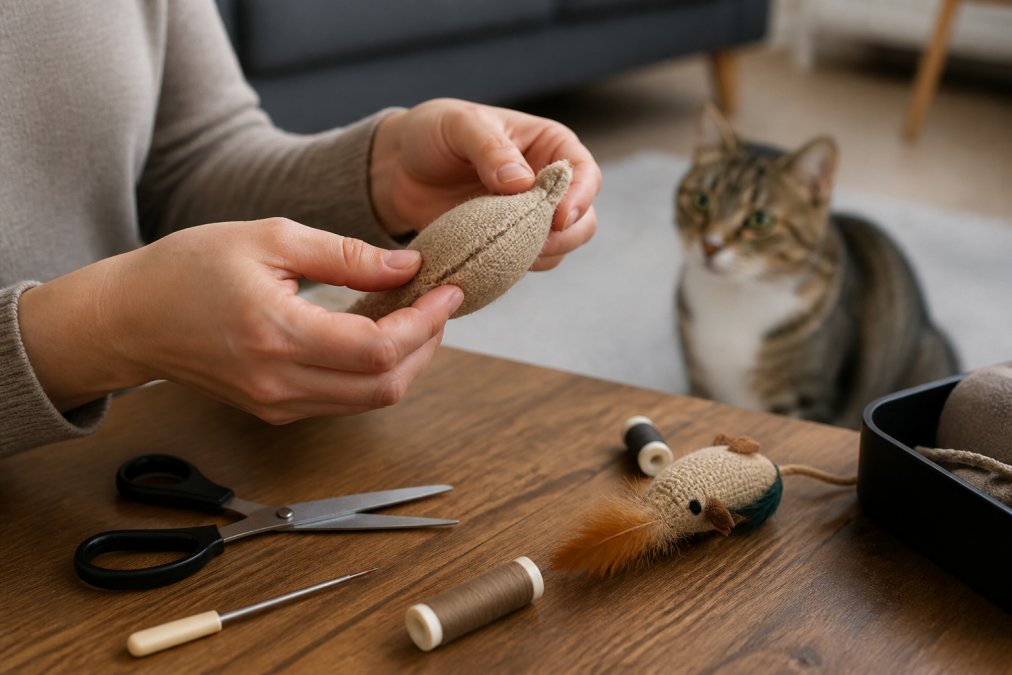
- Squeeze the seams. Run your thumb along every stitched edge. If you feel gaps or loose thread, the seam is failing.
- Check for exposed filling. Any visible stuffing means the outer layer has breached.
- Test attachments. Tug gently on bells, feathers, and eyes. If they move, they'll come off.
- Look for cracks in rubber and plastic. Small cracks become large breaks under jaw pressure.
- Smell the toy. A sour or chemical odor can indicate bacterial growth or material breakdown.
When to Repair and When to Replace
Repair makes sense for high-quality toys with one failing seam. A few minutes with a needle and heavy thread can extend a toy's life significantly.
Replace any toy that has:
- Multiple failing seams
- Exposed or leaking stuffing
- Cracked rubber or plastic
- Missing attachments
- A persistent odor
Repairability is one of the most overlooked factors in toy selection. Toys with accessible seams and simple construction are worth fixing. Toys sealed with glue or hidden stitching usually aren't.
Choosing Toys Based on Age, Activity Level, and Supervised Play
Age changes durability needs more than most owners realize, and the failure modes are different at every stage. A toy that survives an adult cat's predatory aggression can be shredded by a teething kitten, and a toy built for a kitten's needle teeth can be torn apart by a senior cat's determined grip. Match the toy to the life stage, not just the cat.
Kittens: Puncture Resistance Over Tensile Strength
Kittens have sharp deciduous teeth but limited jaw strength. Their damage pattern is puncture, not tear, dozens of small holes rather than one long rip. That means the durability metric that matters is puncture resistance, not seam tensile strength.
- Best bets: tightly woven canvas, solid rubber, thick felt with no loose fill.
- Avoid: thin plush, loosely knit fabric, anything with glued-on eyes or bells a kitten can pry off during teething.
- Watch for: exposed stuffing through puncture holes. A kitten can pull a strand of polyester fill through a pinhole and swallow it before you notice.
Kitten toys should also be small enough to bat but large enough that they can't be swallowed whole. A common rule of thumb is nothing smaller than a golf ball for unsupervised access.
Adults: Predatory Aggression and Seam Stress
Adult cats with high prey drive attack toys the way they'd attack prey: bite, grip, kick, and shake. The damage pattern is tensile, long tears along seams, ripped attachments, and split rubber at stress points. This is where double-stitched seams, solid rubber cores, and reinforced ends earn their keep.
- Best bets: double-stitched canvas kickers, solid rubber chew toys, wand attachments with swivel hardware rather than glued strings.
- Avoid: single-stitched plush, hollow rubber, any toy with ribbon loops or long cords left out unsupervised.
- Watch for: seam creep, the slow widening of a stitched edge under repeated tugging. Once a seam gap exceeds roughly a quarter inch, the toy is on its way out.
Seniors: Softer Materials, Same Construction Standards
Senior cats have weaker jaws but may still bite, and their claws can be just as destructive. Softer materials can work if they're well-constructed, but the construction standards don't drop, only the material hardness does.
- Best bets: soft wool felt with reinforced seams, lightweight fabric kickers, low-resistance wand lures that don't require a hard pounce.
- Avoid: heavy rubber that's hard to grip, toys that require jumping or hard striking.
- Watch for: dental wear. A senior cat's worn teeth can snag on loose threads and frayed edges, so inspect more often, not less.
Activity Level Changes the Rotation, Not the Build
High-activity cats need toys that can handle repeated strikes and kicks. Low-activity cats need toys that encourage movement without falling apart from disuse, since stored toys can degrade from dust and humidity. The build quality bar stays the same; what changes is how often a toy cycles through rotation and how quickly it accumulates wear.
Supervised vs. Unsupervised Play
Supervised play matters for any toy with attachments, cords, or small parts. Unsupervised access should be limited to solid, single-piece toys with no removable components. Rotate toys weekly to prevent boredom and to give yourself a chance to inspect each one.
You can also enrich solo play with durable electronics. ELTStores carries a remote control flying fish that moves up and down with a full 360-degree range and reaches up to 40 feet. It's rechargeable and built for indoor use, giving cats a chase target that doesn't shred after a week.

Frequently Asked Questions
What materials make cat toys the most durable?
Sisal rope, reinforced stitching, and thick natural fibers hold up best against claws and teeth. Rubber toys with no small parts work well for aggressive chewers. Avoid thin synthetic fabrics that shred quickly. Check for non-toxic materials, especially if your cat mouths toys often. Rotating toys also extends their life by reducing constant wear on any single item.
How can I tell if a cat toy is safe for aggressive chewers?
Look for durable construction with no swallowable parts. Avoid toys with glued-on eyes, bells, or feathers that can detach. Reinforced stitching and solid rubber or sisal rope are safer choices. Supervise play with wand toys and anything on a string. Inspect toys weekly for loose threads, cracks, or exposed stuffing, and remove damaged toys immediately to prevent choking hazards or ingestion risks.
How often should I inspect cat toys for wear and tear?
Check all toys weekly, and inspect favorites daily if your cat plays hard. Look for frayed seams, exposed stuffing, loose attachments, or cracked rubber. Toys used by aggressive chewers need closer monitoring. Replace wand toys with frayed strings right away since ingestion risks are high. A quick five-minute inspection routine prevents most emergencies and keeps play sessions safe and mentally stimulating for your cat.
Are there specific toy designs that withstand rough play?
Yes. Wand toys with interchangeable attachments let you swap worn pieces instead of replacing the whole toy. Solid rubber balls, sisal-wrapped posts, and crinkle texture toys with double-stitched seams last longer. Puzzle feeders made from hard plastic resist chewing better than fabric. Avoid toys with glued-on parts or thin strings. Rotating durable cat toys every few days also reduces destruction by keeping novelty high and boredom low.
Cats destroy toys because toys weren't built for how cats actually play. Matching construction to playstyle, inspecting regularly, and choosing repairable designs changes everything. ELTStores curates pet accessories and lifestyle products designed to last, from durable ABS plastic communication buttons to rechargeable interactive toys that hold up to daily use. Browse the collection and find pieces that bring calm, comfort, and a little joy into your home.