

Table of Contents
- Start With Decluttering for Mental Clarity
- How to Create a Tranquil Living Space With Layered Lighting
- Calm Interior Design Ideas That Go Beyond Beige
- How to Incorporate Mindfulness Into Busy Schedules
- Quiet the Room: Acoustic Comfort and Sensory Calm
- Bring the Outdoors In With Biophilic Design
- How to Create a Tranquil Living Space on a Budget
- Layout, Flow, and the Psychology of Arrangement
- Frequently Asked Questions
Last Updated: September 14, 2026
Start With Decluttering for Mental Clarity
Learning how to create a tranquil living space starts with subtraction, not addition. Clutter competes for attention every time you enter a room, and that low-grade cognitive pull is the opposite of rest.
Decluttering for mental clarity means removing objects that demand decisions. A stack of unopened mail, a chair piled with laundry, a shelf of things you meant to sort: each one is an open loop. Close the loops and the room gets quieter before you change a single thing about the decor.
The most useful reframe is this: you are not organizing, you are editing. Organization stores more stuff. Editing decides what deserves to stay.
The 20-Minute Reset for High-Traffic Rooms
High-traffic rooms (entryways, kitchens, living rooms) accumulate clutter fastest. A 20-minute reset works because it has a hard stop and a single rule: everything either has a home or leaves the room.
- Set a timer for 20 minutes.
- Take one surface at a time, starting with the one you see first when you walk in.
- Sort into three piles: belongs here, belongs elsewhere, belongs gone.
- Walk the "elsewhere" pile to its actual home before the timer ends.
- Wipe the cleared surface.
Do this once a week per room and you will rarely need a full decluttering session. The point is maintenance, not heroics.
What to Do With Sentimental Items
Sentimental items are where most decluttering attempts stall. The mistake is treating them as clutter to eliminate. They are not. They are memory, and memory deserves a designated place.
Try a memory box per person or per era, sized so it has to be edited. Photograph items you love but do not need to hold. Rotate a few pieces into display and store the rest. What matters is that the item has a boundary, so it stops spreading across every surface in the house.
How to Create a Tranquil Living Space With Layered Lighting
Lighting is the single highest-use change you can make to a room, and most homes get it wrong by relying on one overhead fixture. A tranquil living space depends on layered light, not brighter light.
Think of lighting in three tiers, each doing a different job. When all three are present and dimmable, a room can shift from functional to restful in seconds.
Ambient, Task, and Accent: The Three Layers
Ambient lighting is the base layer: the general glow that lets you move around safely. It should never be the only layer.
Task lighting is directional light for reading, cooking, or working. A floor lamp beside an armchair, a pendant over a counter.
Accent lighting is decorative and low. It creates depth and draws the eye. A wall-mounted fixture, a candle, a small lamp on a shelf.
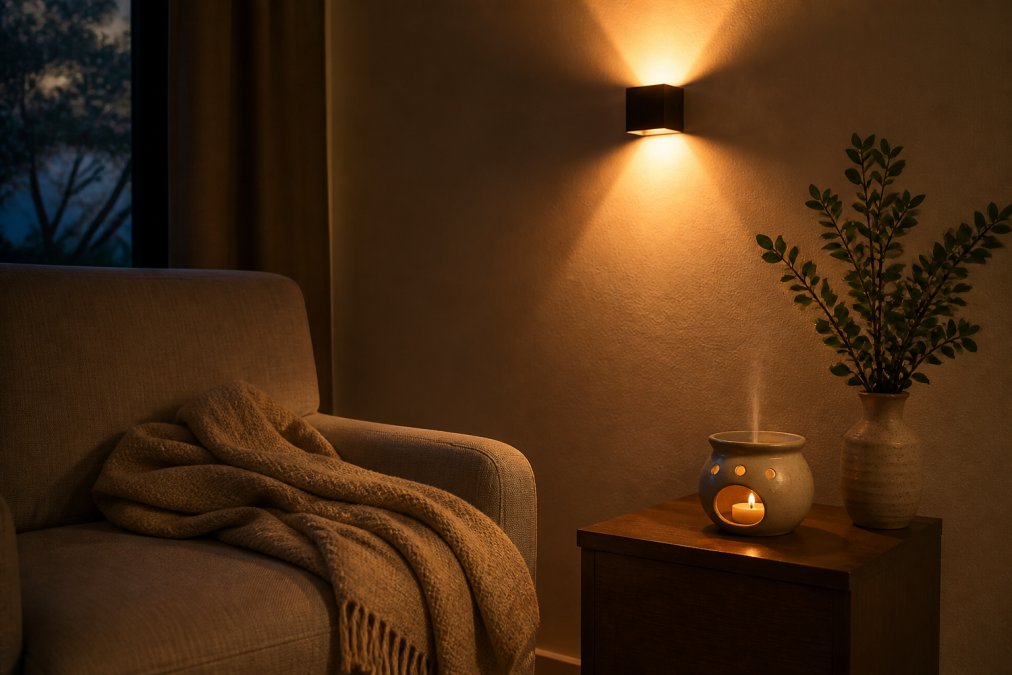
A simple upgrade is swapping a harsh overhead bulb for a dimmable warm-white fixture, then adding one accent source per room. Products like the LED Color-Changing Wall Light handle the accent layer well because you can dial the color toward warm amber in the evening and keep it low.
Working With Circadian Rhythm, Not Against It
Your body reads light color as a time signal. Cool, bright light in the morning supports alertness; warm, dim light in the evening supports the wind-down your nervous system needs (Effects of light on human circadian rhythms, sleep and mood).
The practical rule is simple: bright and cool before noon, warm and low after sunset. If your overhead lights are fixed cool-white, add lamps you can dim and use those after dinner. This is one of the most underrated calm interior design ideas because it costs nothing beyond a bulb change.
Calm Interior Design Ideas That Go Beyond Beige
A calm room is not a colorless room. The beige-everything approach often reads as flat rather than peaceful, because it removes contrast without adding interest.
What actually creates calm is a narrow palette with real variation in texture and depth. Two or three related hues, several materials, and one deliberate point of contrast will do more than an all-neutral scheme.
Neutral Palettes and Color Psychology
Neutral palette design works when you choose neutrals with undertones that agree. Warm whites, oatmeal, clay, and soft taupe sit together comfortably. Drop a single cool gray into that mix and the whole room feels slightly off, even if nobody can name why.
Color psychology matters here too. Muted greens and blues tend to read as restful, while saturated reds and oranges raise arousal (pubmed.ncbi.nlm.nih.gov). That does not mean you cannot use them. It means using them in small doses, on objects you can move.
Textiles, Texture, and Tactile Comfort
Tactile comfort is the difference between a room that looks calm in a photo and one that feels calm to sit in. Texture is how you add visual interest without adding visual noise.
Layer materials with different weights and finishes: a chunky knit throw, velvet cushions, a bouclé armchair, a woven jute rug, linen draperies. Aim for at least three distinct textures in any seating area.
How to Incorporate Mindfulness Into Busy Schedules
Knowing how to incorporate mindfulness into busy schedules is less about finding extra time and more about attaching small practices to moments that already exist. You do not need a meditation cushion or a silent hour.
The barrier most people hit is the belief that mindfulness requires a dedicated block of time. It does not. It requires a cue, a sensory anchor, and about two minutes.
Two-Minute Anchors: Scent, Sound, and Stillness
An anchor is a repeated sensory cue that tells your body the pace has changed. Scent and sound work better than visual cues because you can engage them with your eyes closed.
- Scent: A backflow incense burner or a diffuser placed where you naturally pause. The Purple Sand Ceramic Backflow Incense Burner doubles as a visual focal point, which helps the ritual stick.
- Sound: A small speaker playing one consistent ambient track at low volume, so the sound itself becomes the signal. The SZGMJIA LED Flame Speaker combines a warm flickering light with audio, so one object covers two sensory channels.
- Stillness: Two minutes of sitting without a screen, ideally in the same chair each time.
The consistency matters more than the duration. Two minutes daily beats twenty minutes once a month.


Quiet the Room: Acoustic Comfort and Sensory Calm
Sound is the most neglected element in home design, and it is often the reason a beautifully decorated room still feels tense. Acoustic comfort means reducing echo, softening hard reflections, and masking the sharp sounds that jolt your attention.
Hard surfaces bounce sound. Tile floors, bare walls, glass tables, and open-plan layouts all extend reverberation time, which makes even quiet conversation feel louder (Assessing the Acoustic Characteristics of Rooms: A Tutorial with Examples). The fix is absorption: rugs with pads, upholstered furniture, curtains, wall hangings, and bookshelves all break up reflections.
For masking, a consistent low-level sound is more soothing than silence. Steady ambient audio smooths over traffic, neighbors, and appliance noise without demanding attention. This is where a small speaker earns its place in a calm room.
Bring the Outdoors In With Biophilic Design
Biophilic design is the practice of incorporating natural elements into interior spaces to support attention and reduce stress. It is one of the better-supported ideas in interior design, and it is also one of the cheapest to start.
You do not need a living wall. A few well-chosen elements deliver most of the benefit:
- One large plant near a window, or two smaller ones where light allows
- Natural materials in visible places: wood, stone, wool, linen, clay
- A view of something green, even if it is a single tree outside
- Natural light left unobstructed during the day
The strongest version of this is a sightline. If you can see a plant, a natural texture, and daylight from your usual seat, the room is doing most of the work already.
How to Create a Tranquil Living Space on a Budget
A calm home is not a spending category. Most of what makes a room restful is arrangement, light, and subtraction, none of which require a budget.
The trap is buying decor to fix a feeling. If a room feels restless, the answer is usually removing something or changing the light, not adding another object.
| Priority | What to Do | Typical Cost | Impact |
|---|---|---|---|
| 1 | Declutter one high-traffic surface | $0 | High |
| 2 | Swap to warm, dimmable bulbs | Low | High |
| 3 | Add one rug with a pad | Low to moderate | High |
| 4 | Introduce two textures (throw, cushions) | Low | Moderate |
| 5 | Add one plant or natural object | Low | Moderate |
| 6 | Add an ambient sound source | Varies | Moderate |
DIY Swaps Under $75
These are the changes that deliver the most calm per dollar:
- Replace cool-white bulbs with warm dimmable ones in the rooms you use at night
- Move a lamp from a corner into the seating zone so light lands where you sit
- Add a rug pad under an existing rug to cut echo
- Rearrange one chair so it faces something restful instead of a doorway or screen
- Repurpose a tray to corral small objects on a single surface
What to Buy Once and Keep for Years
A few purchases are worth making deliberately because they last and they set the tone for everything around them. A well-made incense burner, a reliable ambient speaker, a good light-blocking eye mask for sleep, and one genuinely comfortable chair.

The Memory Foam Eye Mask is a good example of a small item that supports the larger goal: it removes light so rest actually happens, which is the point of a tranquil room. ELTStores curates pieces like these specifically because they earn their place rather than adding to the pile.
Layout, Flow, and the Psychology of Arrangement
Furniture placement changes how a room feels more than any single object in it. Spatial flow is the path your body takes through a room, and a blocked or ambiguous path creates subtle friction every time you cross it.
Three layout rules do most of the work:
- Leave a clear walking path at least 36 inches wide through main routes.
- Anchor seating around a focal point (a window, a fireplace, a piece of art) rather than facing a screen by default.
- Pull furniture slightly away from walls so the seating area reads as intentional.
The psychological effect is real. Rooms with a defined center feel settled; rooms where furniture is pushed to the perimeter feel like waiting areas. If you want to know how to create a tranquil living space in a single afternoon, rearranging seating is often the answer.
Maintenance keeps all of this from decaying. A five-minute nightly reset, a weekly surface wipe, and a seasonal edit of what has crept back in will hold the room at calm far longer than one big effort.
Most homes do not feel restful because they were never designed to be, not because the people in them did anything wrong. The fix is a set of small, repeatable changes: clear the surfaces, layer the light, soften the sound, add texture, and arrange the room around something worth looking at. ELTStores carries the pieces that make those rituals easier to keep, from a handcrafted backflow incense burner that anchors an evening wind-down to a flame-lit speaker that handles both sound and accent light, plus small comforts like a contoured memory foam eye mask for deeper rest. Shop now at ELTStores and give yourself a home that makes room for rest, reflection, and gentle joy.
Frequently Asked Questions
How do I create a tranquil living space in a small apartment?
Focus on three things: vertical storage to clear floor space, layered lighting instead of one overhead fixture, and a single calming focal point like a wall light or incense burner. In small rooms, clutter reads louder, so run a five-minute reset each evening and keep surfaces 70% clear. Choose multi-use pieces, such as an ottoman that stores blankets, so every item earns its footprint.
What color palettes promote a tranquil home environment?
Warm neutrals, soft sage, muted clay, and dusty blues tend to calm a room because they reduce visual contrast. Color psychology suggests low-saturation tones let the eye rest instead of constantly re-focusing. You do not have to paint everything beige. Pick one neutral base, add one muted accent, and let texture do the work. A single richer tone on a focal wall adds depth without noise.
How does decluttering contribute to a tranquil living space?
Visual noise keeps your brain scanning for unfinished tasks. When every surface holds mail, cables, or stray items, your nervous system stays slightly on alert. Decluttering for mental clarity works because it removes those micro-triggers. Start with one drawer or one shelf, not the whole house. A 20-minute timer per room, once a week, is enough to keep momentum without feeling overwhelmed.
What are the best lighting techniques for a peaceful home?
Use three layers: ambient light for overall glow, task light where you read or work, and accent light for warmth. Swap harsh overhead bulbs for warm-white LEDs around 2700K, add dimmers where possible, and place a small lamp or wall light at eye level rather than ceiling height. In the evening, lower the brightness an hour before bed to support your circadian rhythm and make winding down easier.