

Table of Contents
- Mindful Interior Design Principles: Building Calm by Design
- How to Avoid Clutter in Small Apartments Without Feeling Deprived
- Neutral Palettes and Natural Materials That Ground a Room
- Minimalist Meditation Room Ideas for a Dedicated Calm Corner
- Digital Minimalism Integration: Extending Minimalist Decor Beyond the Physical
- Budget-Friendly Mindful Minimalism: Getting the Look for Less
- Frequently Asked Questions
Last Updated: September 26, 2026
Mindful Interior Design Principles: Building Calm by Design
Mindful interior design is the practice of shaping a home around how you want to feel, not just how you want it to look. At ELTStores, we see this shift in what people bring into their spaces: fewer objects, chosen with more care. The goal behind most minimalist decor ideas for mindful living is simple. Every item earns its place, and the room starts working for your nervous system instead of against it.
Function First, Form Follows
Start with what the room needs to do. A bedroom needs to support sleep. A hallway needs to move you through without friction. Once you name the function, the form almost picks itself, and you stop buying pieces that look good in a photo but serve nothing.
The Role of Natural Light and Circadian Rhythm
Light is the most underrated design material in any home. The body's internal clock, or circadian rhythm, responds to the color temperature of light around it: cooler, brighter light in the morning supports alertness, while warmer, dimmer light in the evening signals the body to wind down.
How to Avoid Clutter in Small Apartments Without Feeling Deprived
Knowing how to avoid clutter in small apartments comes down to one principle: give every object a fixed home, and remove anything that has no home. Deprivation is not the goal. You are not throwing away things you love. You are removing the things you never chose in the first place.
- Clear one surface completely, such as a coffee table or nightstand.
- Put back only what you used in the last week.
- Store the rest out of sight for two weeks.
- Donate whatever you did not miss.
The One-In-One-Out Rule That Actually Sticks
Most people abandon the one-in-one-out rule because they apply it to everything at once. Narrow it instead. Pick three categories only, such as mugs, throw blankets, and candles, and hold the line there. When a new mug comes in, one leaves. Keeping the rule small is what makes it survive past the first month.
Neutral Palettes and Natural Materials That Ground a Room
A neutral palette works because it removes visual noise. Soft grey, beige, and egg white walls let texture carry the interest instead of color, and texture is what makes a minimal room feel warm rather than clinical. That part every guide gets right. What most of them skip is why texture actually calms you, and which textures do it best.
Why Texture Calms the Nervous System
The skin is the body's largest sensory organ, and slow, predictable tactile input is one of the fastest ways to signal safety to the nervous system. When your hand passes over a rough ceramic glaze or a grained walnut surface, mechanoreceptors in the skin send a steady, low-variability signal to the brain. That signal competes with the higher-variability input of notifications, screens, and visual clutter, and it tends to win.
A Texture Hierarchy You Can Actually Shop From
Not all textures produce the same effect. Ranked from most grounding to least, based on how much variation and resistance they offer the hand:
- Unglazed clay and raw ceramic. High resistance, cool to the touch, slight grit. The strongest single anchor.
- Open-grain wood (walnut, oak, reclaimed pine). Warm, directional grain, responds to room temperature.
- Wool, linen, and raw cotton. Soft but with visible weave; best for surfaces you sit or lie on.
- Brushed or hammered metal. Cool, reflective, better as an accent than a primary texture.
- Glossy laminate, polished stone, and vinyl. Low resistance, low variation. Use sparingly.
How to Apply It Without Overbuying
Choose two or three materials from the top of that list and repeat them across the room. Repetition is what makes a neutral palette read as intentional rather than unfinished. A single unglazed ceramic vessel on a walnut console, a linen throw over a wool rug, and a raw clay incense burner on a stone tray is enough.

The Trade-Off Nobody Mentions
Tactile materials require maintenance. Unglazed clay stains, raw linen wrinkles, and open-grain wood needs occasional oiling. If you want a home you can wipe down with a single spray bottle, lean toward brushed metal and sealed wood instead and accept a slightly cooler feel. Mindful minimalism is not about pretending the trade-off does not exist; it is about choosing the one you can actually live with.
Minimalist Meditation Room Ideas for a Dedicated Calm Corner
The best minimalist meditation room ideas do not require a spare room. A corner is enough. What matters is that the space is dedicated, consistent, and free of anything that pulls your attention elsewhere.
Purple Sand Ceramic Backflow Incense →
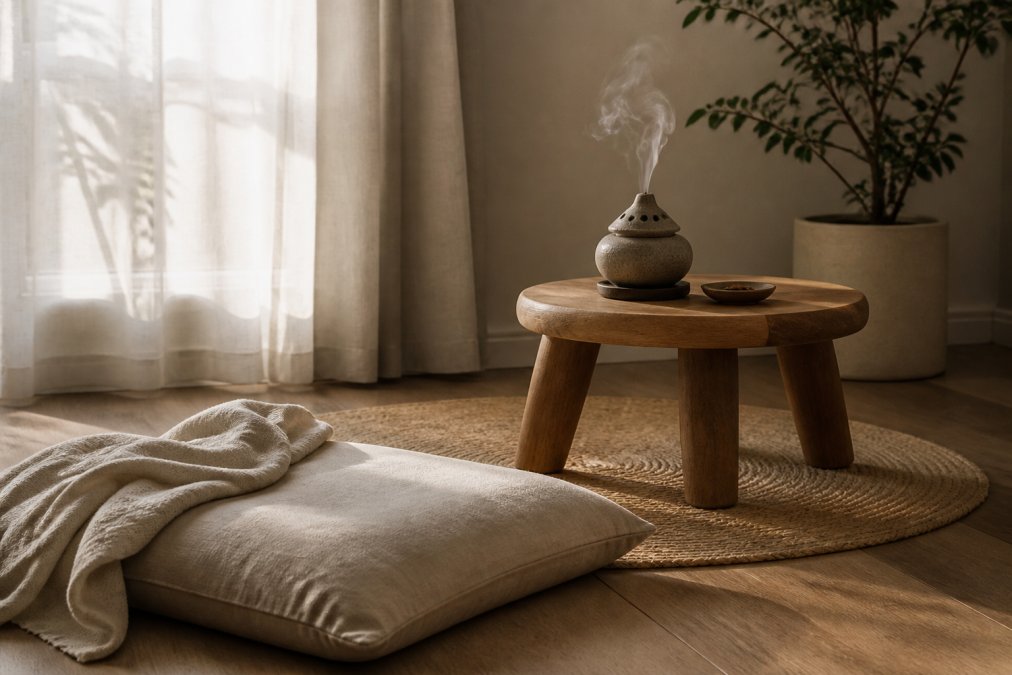
Set the corner up in three layers:
- A seat. A low stool or cushion that you only use for sitting quietly.
- A focal object. One item your eyes can rest on, such as a small sculpture or a single plant.
- A sensory cue. A scent, a texture, or a soft light that signals "this is the calm corner."
Choosing the Right Incense and Ambiance
Scent is the fastest way to shift a room's atmosphere. Agarwood and sandalwood are the traditional choices for quiet sitting because they burn slowly and stay subtle. A backflow burner adds a visual element too: the smoke cascades downward like a small waterfall, which gives your eyes something gentle to follow while you breathe. The Purple Sand Ceramic Backflow Incense Burner is handcrafted from purple clay pottery and made for exactly this kind of corner.
Digital Minimalism Integration: Extending Minimalist Decor Beyond the Physical
Digital minimalism is the practice of applying the same "does this earn its place" test to your screens, notifications, and devices that you apply to your furniture. A calm room with a buzzing phone on the nightstand is not a calm room.
Try these three moves:
- Charge your phone outside the bedroom.
- Turn off all non-human notifications.
- Keep one visible device in shared spaces, not three.
Budget-Friendly Mindful Minimalism: Getting the Look for Less
Mindful minimalism costs less than maximalism, not more, provided you resist the urge to buy a whole new set of things to achieve the look. The single most expensive mistake in this style is treating it as a shopping list. The second most expensive is buying cheap versions of the few pieces you touch every day, then replacing them within a year.
The Mindful Curation Method
Before you buy anything, run every existing object in the room through three questions:
- Did I choose this, or did it arrive? Gifts, hand-me-downs, and impulse buys often fail here. They are not bad objects; they are just not yours.
- Do I touch it or look at it at least weekly? If not, it is a candidate for storage or donation.
- Does it match one of my two or three chosen materials? If it is the only glossy plastic item in a room of clay and wood, it will read as noise no matter how useful it is.
Where to Source Without Spending
- Your own storage. Most people find two to four usable pieces per room they had forgotten about. Shop your closets before you shop anywhere else.
- Thrift and estate sales. Unglazed pottery, solid wood furniture, and linen textiles show up constantly and often cost less than new fast-furniture equivalents. Check for chips on ceramic and wobble on wood before buying.
- Buy-nothing exchanges. Neighborhood and workplace swap groups are the cheapest source of throw blankets, baskets, and small decor. The catch is selection: you take what appears, not what you want.
- Facebook Marketplace and Craigslist. Best for one large piece at a time. Solid wood side tables and consoles routinely list for a fraction of retail, but you need a vehicle and patience.
Where to Spend, and Where Not To
| Priority | Where to Spend | Where to Save |
|---|---|---|
| Seating and sleep | Mattress, one good chair | Side tables, shelving |
| Lighting | One dimmable warm lamp | Overhead fixtures |
| Texture | One wool or linen throw | Extra cushions |
| Scent | One quality incense burner | Bulk candles |
| Decor | One focal object per room | Filler accessories |
The rule behind the table: spend on the pieces your body contacts daily and on the one object your eyes rest on. Save on everything that only exists to fill a gap. A single well-made object, such as a Tree of Life Ring in antique silver or a strand of Tibetan Sky Eye agate beads, can act as the one personal detail that keeps a minimal room from feeling anonymous. Buy one, not five.


The Real Cost Trap
Minimalism has a hidden recurring cost: the replacement cycle. If you buy a cheap lamp, a cheap throw, and a cheap chair, you will likely replace all three within two years, and the total spend will exceed what one good version of each would have cost. The budget-friendly move is not to buy the cheapest option. It is to buy fewer things, at the middle of the quality range, and keep them long enough that the per-year cost drops below the fast-furniture alternative.
Frequently Asked Questions
What are good minimalist decor ideas for a small apartment?
Focus on multi-functional pieces and vertical storage. Use a neutral palette with soft grey or beige walls to make the space feel larger. Choose furniture with clean lines that serves two purposes, like a storage ottoman or a wall-mounted shelf. Keep surfaces mostly clear, and add one or two tactile accents like a reclaimed wood tray or a textured throw. The goal is open space that feels calm, not empty.
How can minimalist decor improve mental well-being?
A clutter-free environment reduces visual noise, which can lower stress and improve focus. Neutral colors and natural materials create a serene atmosphere that supports relaxation. Incorporating elements like a meditation corner or an incense burner with calming scents can further enhance mindfulness. The intentionality behind minimalist decor, choosing only what serves you, reinforces a sense of control and balance in your daily life.
What are common minimalist decor mistakes to avoid?
One common mistake is confusing minimalism with emptiness. A room can feel cold and unwelcoming if you remove all texture and warmth. Avoid ignoring lighting; harsh overhead lights kill the calm. Another mistake is buying cheap, disposable items that clutter again quickly. Instead, invest in a few quality pieces that you love, like a handcrafted ceramic burner or a soft memory foam eye mask for rest. Also, don't forget practical storage.
How do you balance minimalism with a cozy home atmosphere?
Layer textures and warmth. Use soft textiles like wool throws, linen curtains, and a plush rug. Add warm lighting with dimmable bulbs or a color-changing LED wall light set to a soft white or amber. Incorporate natural materials such as wood, stone, and clay. A backflow incense burner adds a sensory, cozy element. The key is to keep the overall look uncluttered but invite comfort through touch, scent, and light.